The Response-Time Research, Sorted: What the MIT, HBR and Invoca Numbers Actually Say
The '21x' and '100x' response-time statistics get miscredited constantly, and the confusion has a real cause: the same researcher wrote both the original study and the Harvard Business Review article people confuse it with. Here is what each source actually measured.
By AgentLane Founder · Founder
The "you're 21 times more likely to qualify a lead if you call within 5 minutes" statistic is one of the most repeated numbers in sales and marketing content, and it is very often credited to the wrong source. This isn't a case of one blogger's error copy-pasted a thousand times — the two studies people conflate are genuinely, verifiably connected through a shared author. Here is what each one actually measured, and what the newer data adds.
We corrected part of this in an earlier piece on missed-call text-back for home services, in passing. This post goes further: tracing exactly what each commonly-cited source found, why the mix-up happens, and what a more recent, differently-sourced dataset — Invoca's ongoing call-conversion benchmarking — adds that the older studies can't.
Source one: the 2007 MIT / InsideSales.com study
The original research is the Lead Response Management study, led by Dr. James B. Oldroyd, run in partnership with InsideSales.com and associated with MIT and Kellogg School of Management. It analyzed a large set of leads and call attempts supplied by InsideSales.com's client base, and it is the actual source of the two most-quoted figures in this entire topic:
- Contacting a lead within 5 minutes rather than 30 minutes makes a company roughly 100 times more likely to connect with that lead.
- The same 5-versus-30-minute comparison makes a company roughly 21 times more likely to qualify the lead.
These are odds ratios from one behavioral dataset, not a controlled experiment with random assignment — worth keeping in mind before treating them as a universal constant. They describe what happened in that specific dataset when response time varied, which is different from proving that speed alone caused the outcome in every context. The Revenue.io reference page for this study still attributes it correctly: "Original Kellogg/MIT Study, Dr. James Oldroyd."
Source two: the 2011 Harvard Business Review article — and why it gets conflated with source one
"The Short Life of Online Sales Leads" ran in the March 2011 issue of Harvard Business Review, authored by James B. Oldroyd, Kristina McElheran, and David Elkington. This is a separate piece of research from the 2007 study — a fresh audit, not a republication of the earlier numbers — but it shares an author with it: Oldroyd wrote both.
Here is what the HBR article itself actually found, auditing 2,241 U.S. companies that generate test leads through web forms:
- 37% of companies responded within one hour.
- 16% responded between one and twenty-four hours later.
- 24% took more than twenty-four hours.
- 23% never responded at all.
- Average first-response time across all responders: 42 hours.
- Companies that responded within an hour were roughly seven times more likely to qualify the lead than those responding within 24 hours, and more than 60 times more likely than those responding after 24 hours.
Notice what's absent from that list: the "5 minutes," "21x," and "100x" figures are not HBR's numbers. They belong to the earlier InsideSales/MIT study. The reason the two keep getting merged in popular citation isn't purely a game-of-telephone citation error — it's that the same researcher produced both pieces of work on the same general question four years apart, and "Harvard" is simply a more citable brand name than "InsideSales.com's internal dataset," so the more famous publication absorbed credit for both.
Source three: what Invoca's current data adds
Both studies above are now well over a decade old, drawn from a specific slice of B2B lead-gen behavior in the mid-to-late 2000s. Invoca — a call-analytics company that processes a large volume of real phone conversations for its clients — publishes more current, differently-sourced benchmarking that's worth treating as a separate, complementary data point rather than a refresh of the same numbers.
Invoca's 2026 B2C Buyer Experience Report found that 56% of consumers expect a business to respond within one hour of submitting a form, but only 36% of brands actually meet that window — and 79% of consumers say they'll switch to a competitor that responds faster. Separately, Invoca's analysis of more than 60 million real phone conversations found that 37% of phone leads convert during the call itself, with the strongest-performing industries reaching 46% — a different kind of measurement entirely, since it's observed call outcomes rather than a controlled response-time comparison.
What this adds to the older research: it confirms the same general direction — slower response loses the customer to whoever answers faster — using a current, much larger, and differently-collected dataset. It doesn't repeat the 21x or 100x multipliers, and treating Invoca's numbers as a modern confirmation of those exact figures would be its own small citation error, layered on top of the first one.
The correction, in one place
| Figure | What it actually is | Source |
|---|---|---|
| "100x more likely to connect" (5 vs. 30 min) | Real — 2007 MIT/InsideSales study | Oldroyd, Kellogg/MIT/InsideSales.com |
| "21x more likely to qualify" (5 vs. 30 min) | Real — same 2007 study, widely miscredited to Harvard | Oldroyd, Kellogg/MIT/InsideSales.com |
| "42-hour average response time," "23% never respond" | Real — the actual HBR-published finding | Oldroyd, McElheran & Elkington, HBR, March 2011 |
| "7x more likely to qualify within an hour" | Real — also from the HBR 2011 audit | Oldroyd, McElheran & Elkington, HBR, March 2011 |
| "56% expect a reply within an hour; 36% get one" | Real, current | Invoca 2026 B2C Buyer Experience Report |
| "37% of calls convert live, 46% in top industries" | Real, current, a different metric (call conversion, not response-time comparison) | Invoca, 60M-call analysis |
Everything in that table is a real, sourced figure — the correction is entirely about which source it belongs to, not whether the underlying number exists.
Why this matters beyond trivia
Response-time is the single most load-bearing statistic behind the entire case for any missed-call or slow-reply automation — including the ones we build. Citing it accurately is a credibility question: a reader who catches a wrong attribution has a fair reason to discount everything else in the piece along with it. That's the actual argument for tracing a citation back to its source rather than repeating whatever number is fastest to grab — not pedantry, self-interest in the number staying trustworthy the next time it's cited.
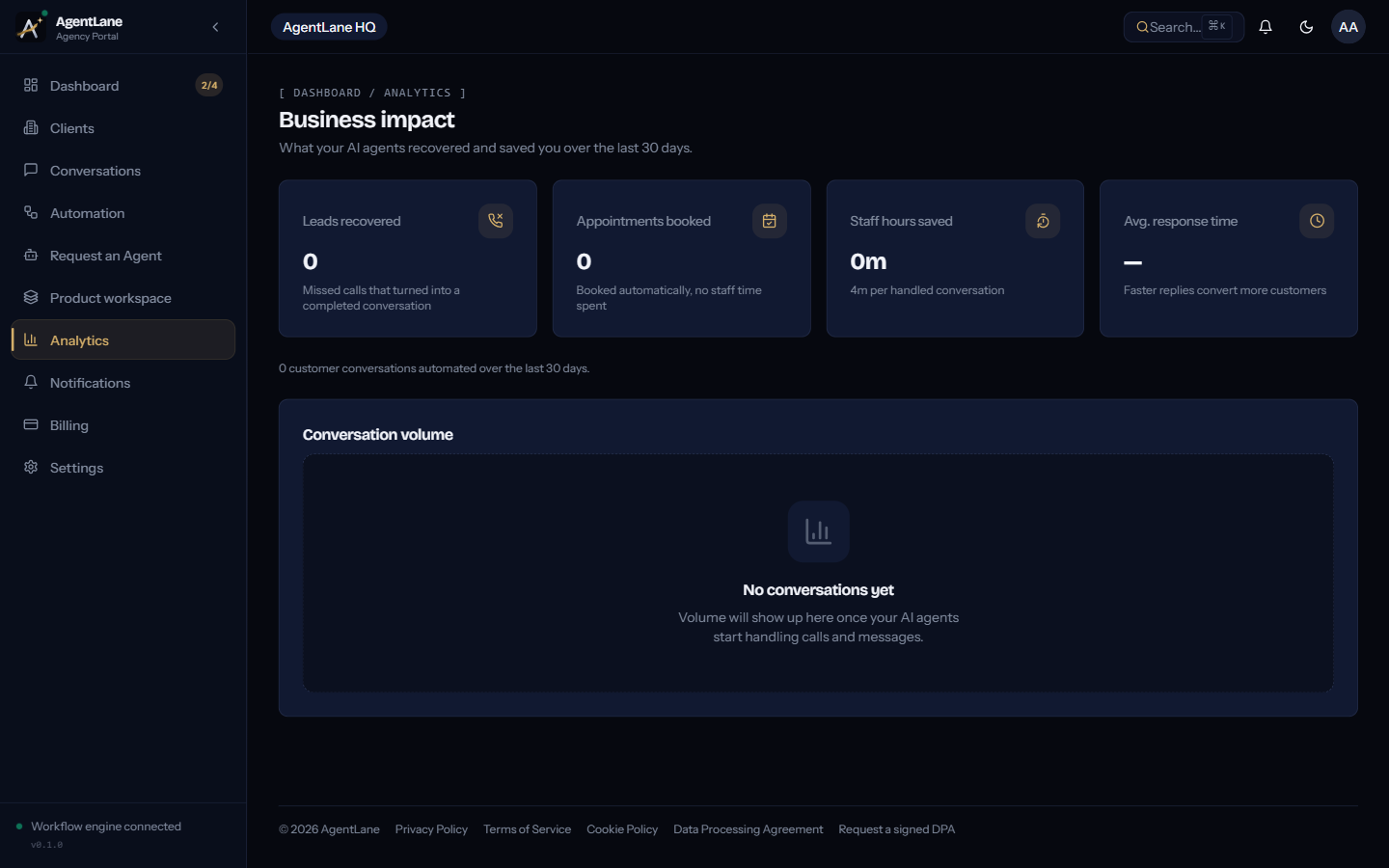
It's also visible in what a live system should be measuring. AgentLane's own analytics view reports average response time alongside recovered leads and bookings, precisely because "how fast did we actually reply" is the number every argument above rests on, not a one-time research citation:
If you're relying on response-speed as the reason to automate anything, that's the number to track after launch, not just cite before it.
Where to start
If you're citing response-time research anywhere in your own sales material, run the specific figure back to this table before using it — a correctly attributed number is a stronger argument than an impressive-sounding one that falls apart under a follow-up question. If you're deciding whether to build something around that research, the missed-call text-back walkthrough covers the practical version, and deploying your first agent covers what actually goes live.
This piece exists because I got tired of seeing "Harvard says" attached to a number Harvard didn't publish, including in some of our own early marketing drafts before we went back and checked. Every figure above is linked to its original or clearly identified source.
Sources:
- Revenue.io — Lead Response Time (Kellogg/MIT Study, Dr. James Oldroyd)
- Harvard Business Review — The Short Life of Online Sales Leads (Oldroyd, McElheran & Elkington, March 2011)
- Invoca — New study: consumers won't wait, AI gives brands the speed to win the sale (2026 B2C Buyer Experience Report)
- Invoca — 5 insights from analyzing 60 million phone conversations
Frequently asked questions
- So is the '21x more likely to qualify' figure real or not?
- It's real, but it's from the 2007 MIT/InsideSales.com study, not Harvard Business Review. It measures the odds of qualifying a lead when contacted within 5 minutes versus 30 minutes, from a behavioral dataset InsideSales.com supplied for that research — not a universal conversion guarantee applicable to any industry or channel.
- Why do people keep attributing it to Harvard?
- Because James B. Oldroyd, the lead author of the original 2007 study, is also a co-author of the 2011 Harvard Business Review article on the same general topic. The two pieces of research are genuinely connected through a shared author — which is a real reason for the confusion, not just a citation error that spread randomly.
- What did the actual HBR article find, then?
- A separate result: a 2,241-company audit found an average first-response time of 42 hours, that 23% of companies never responded to a test lead at all, and that responding within an hour made a company roughly seven times more likely to qualify the lead than responding after 24 hours.
- What does Invoca's more recent data add?
- A present-day, cross-industry measurement rather than a single behavioral dataset from the 2000s — their benchmarking work puts real numbers on how many businesses currently meet consumer response-speed expectations, and how quickly a slow response pushes a customer to a competitor.
- Does any of this apply outside B2B sales?
- The mechanism transfers reasonably well — urgency and having other options are not B2B-specific dynamics — but the exact multipliers do not automatically carry over to a home-services call or a med-spa enquiry. Treat the direction as solid and the specific numbers as belonging to the study that produced them.