Missed Call Text-Back: How Home-Service Businesses Stop Losing Jobs to an Unanswered Phone
A missed call is a customer calling your competitor next. Here is how missed-call text-back works, what it costs, and how to work out what an unanswered phone is costing you.
By AgentLane Founder · Founder
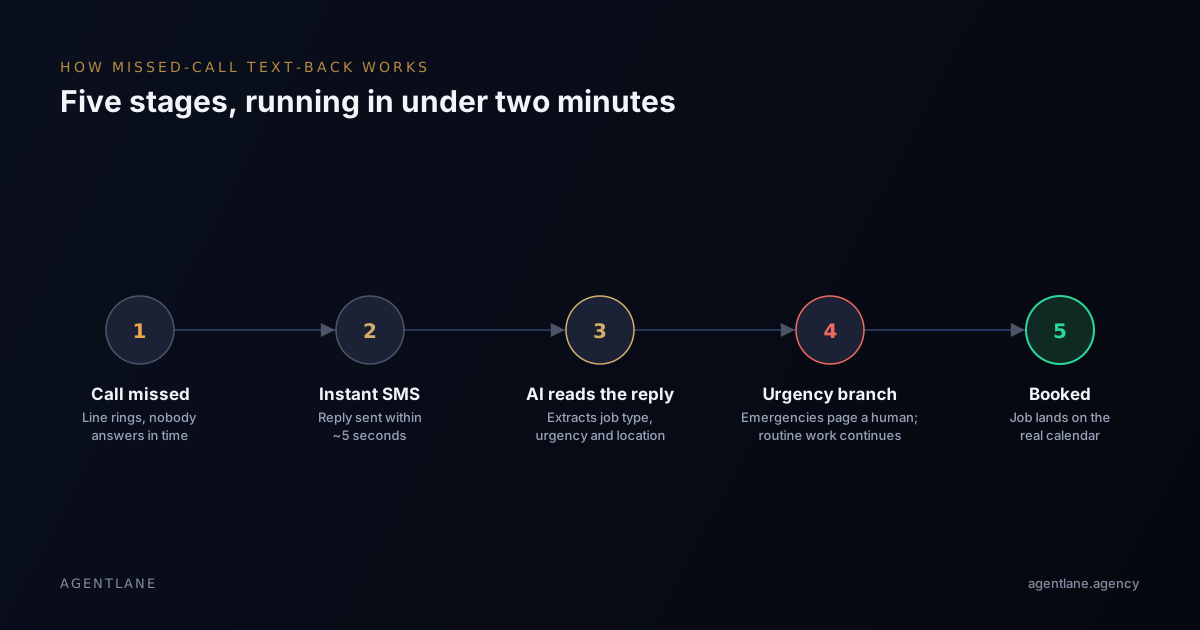
Missed-call text-back is an automation that sends a text message to any caller you could not answer, usually within five seconds, and then handles the conversation that follows — qualifying the job, quoting a window, and booking it into your calendar. It exists because a missed call in home services is rarely a callback. It is a customer dialling the next result.
If you run a plumbing, HVAC, electrical, roofing or property maintenance business, you already know the shape of this problem. The phone rings while you are under a sink, on a roof, or driving between jobs. You see it two hours later. By then the caller has phoned three more companies and booked one of them.
This article covers what the research actually says about response speed, how the automation works step by step, how to calculate what missed calls cost your business specifically, and what to watch out for when you set one up.
How many calls do home-service businesses miss?
More than most owners think.
Call-analytics firm Invoca found that 27% of calls to home-services businesses go unanswered — and that the figure climbs sharply for small and mid-sized operators, who do not have a dedicated person on the phone.
That is the part worth sitting with. The 27% is the industry including large operations with call centres. A two-van outfit where the owner is also the technician is at the bad end of that distribution, not the average.
A word of caution on the numbers you will find elsewhere: search this topic and you will hit a lot of blogs quoting very precise revenue-loss figures — "$285 per missed call", "$120,000 a year" — almost all of them published by companies selling answering services, with no methodology attached. Treat those as marketing. The arithmetic below uses your numbers instead, which is the only version that will actually tell you anything.
Why speed matters more than the callback
The instinct is to say: fine, I miss calls, but I ring everyone back at the end of the day. That closes the loop, but it does not recover the job, and there is a well-known body of research on exactly why.
The most-cited work is the 2007 MIT / InsideSales.com Lead Response Management study by Dr James Oldroyd, which analysed over 15,000 leads and 100,000 call attempts across three years. Its headline finding: contacting a lead within five minutes rather than thirty makes you roughly 100 times more likely to connect and 21 times more likely to qualify them.
Separately, a 2011 Harvard Business Review audit of 2,241 companies found the average first response took 42 hours, that 23% of companies never responded at all, and that firms responding within an hour were about seven times more likely to qualify the lead.
Two caveats, because they matter for how much weight you put on this:
- These are B2B sales studies, not home-services studies. The mechanism transfers — urgency, first-mover advantage, a buyer with other options — but the exact multipliers do not.
- The "21x" figure is very widely miscredited to Harvard. It is the MIT/InsideSales study. The HBR study is the 42-hour one.
What survives the caveats is the direction, and it is not subtle: the value of a response decays fast, and it decays fastest in the first few minutes. In a trade where the customer has a burst pipe and eight other numbers to try, "fast" is measured in seconds.
How missed-call text-back works, step by step
The automation is simpler than it sounds — the diagram at the top of this article shows the shape of it. A working setup has five stages:
1. The trigger. Your business line is configured so that an unanswered or busy call fires a webhook. This does not require changing your number — it is normally done by porting the number to a programmable telephony provider, or by conditional call-forwarding to a tracking number that then rings your existing phone.
2. The instant reply. Within a few seconds the caller receives an SMS. The wording carries almost all the weight here. "Sorry we missed you" is a dead end. What works is an acknowledgement plus a single specific question:
Hi, this is Dave at [Company] — sorry I couldn't pick up, I'm on a job. What's the issue and which postcode are you in? I can get you a time today.
3. Understanding the reply. The customer texts back in plain language — "boiler's leaking, no hot water, SW11". A language model reads that and extracts the job type, the urgency, and the location, rather than forcing the customer through a phone-tree of numbered options.
4. Branch on urgency. Emergencies do not get automated. A leak, no heat in winter, or anything with a safety dimension should page you directly and immediately. Routine work — a quote, a service, a non-urgent repair — continues in the automated thread.
5. Book it. For routine work the agent offers real slots from your live calendar, confirms one, writes the job into your scheduling software, and sends the confirmation. You come off the roof to a booked job rather than a voicemail.
The whole exchange typically resolves in under two minutes of the customer's time, and none of yours.
This is close to a description of AgentLane's own Lead Qualifier agent, which scores the inbound reply, checks a live Cal.com calendar, and branches to a booking, a nurture email, or a Slack alert depending on what it finds — the run shows up in the live executions feed the same way any other job would:
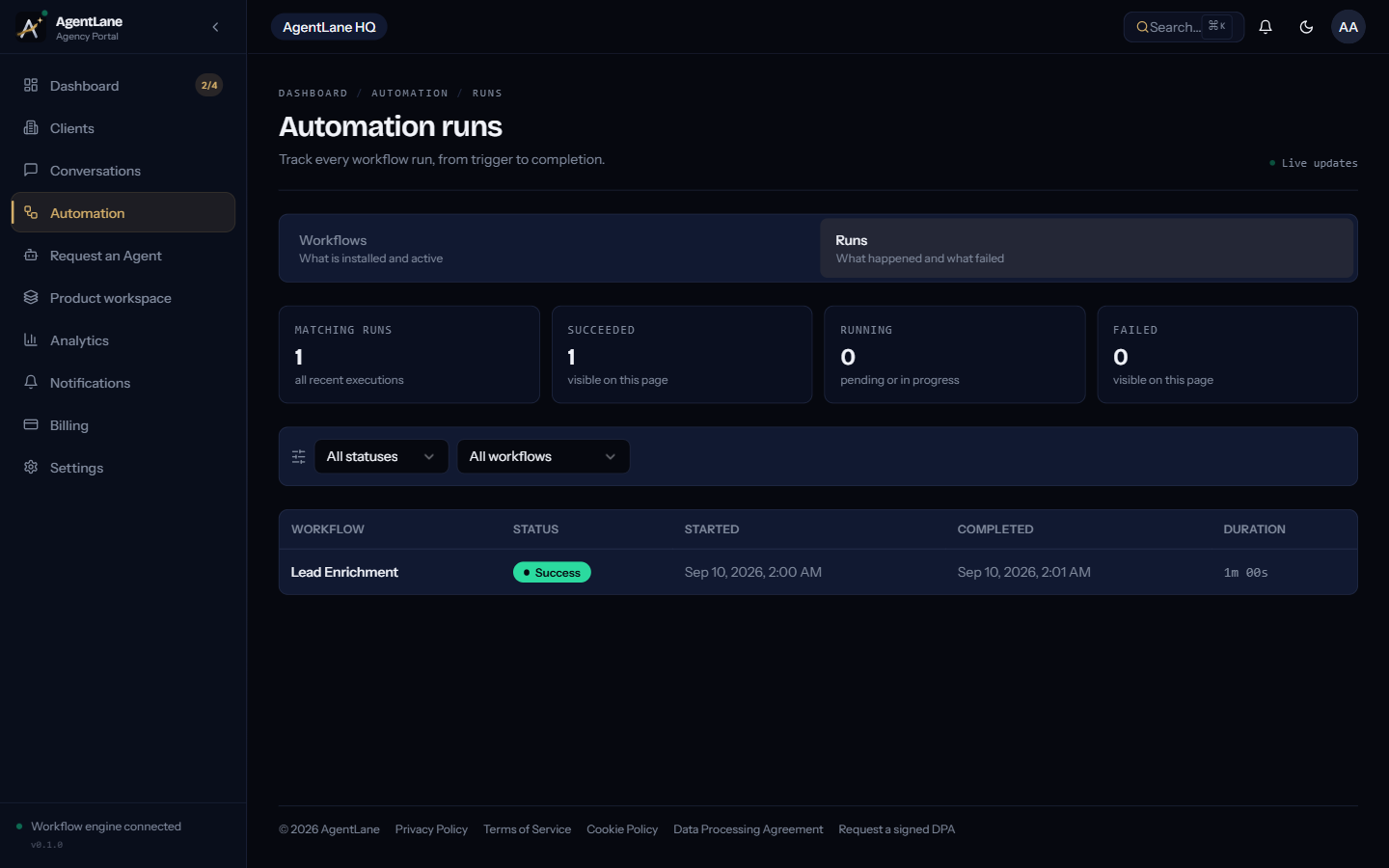
If you're an agency partner setting this up for a client rather than reading this as the client, deploying a Lead Qualifier agent walks through the exact same five stages above, screen by screen. The same pattern applies to appointment-heavy verticals too — see how it plays out for dental practices specifically.
What is it worth to you?
Here is the calculation, with your own figures. You need four numbers:
| Input | Where to get it |
|---|---|
| A — calls per week | Your phone bill or call log |
| B — % you miss | Same log. Count a week honestly. Most owners guess low. |
| C — your average job value | Last 20 invoices, divided by 20 |
| D — your close rate on answered enquiries | Roughly, quotes won ÷ enquiries taken |
Then:
Weekly opportunity = A × B × C × D
Worked example. A plumbing business taking 60 calls a week, missing 30%, average job $220, closing 40% of the enquiries it does answer:
60 × 0.30 × $220 × 0.40 = $1,584 per week of missed-call opportunity
Now the important part, and the part the vendor blogs skip: you will not recover all of it. Some of those callers already booked someone else. Some are suppliers. Some are wrong numbers. A realistic recovery rate for a well-written text-back flow is a fraction of that number — and anyone quoting you a guaranteed percentage without seeing your call data is guessing.
Even at a conservative quarter recovery, though, the example business is looking at roughly $400 a week, against a build cost in the low four figures and a small monthly run cost. That is the honest version of the case, and it is still a strong one.
Run the numbers before you buy anything. If A × B × C × D is small for your business, this automation is not your bottleneck and you should spend the money elsewhere.
What to watch out for
Do not let it lie. The text should never imply a human is typing if one is not. Beyond the ethics, customers work it out within two messages and the trust cost is worse than the missed call.
Emergencies must escalate to a person. Any flow that tries to handle a gas smell or a flood conversationally is a liability. Classify hard, page fast, and route the ambiguous cases to a human by default.
Compliance is not optional. Automated SMS is regulated — TCPA and 10DLC registration in the US, PECR/GDPR in the UK and EU. A reply to an inbound call from the caller is on much safer ground than outbound marketing, but "much safer" is not "exempt". Get the opt-out language and the registration right at build time.
Watch the handoff. The most common failure is not the AI — it is the booked job never reaching the calendar the technician actually looks at. Test the whole chain, including what happens when the calendar API is down.
Keep a human override. You should be able to take over any conversation from your phone, mid-thread, without ending the automation.
Where to start
If you take one thing from this: count your missed calls for one week before you do anything else. Not an estimate — the actual log. That single number determines whether this automation is worth building for you, and it is the number every honest vendor will ask for first.
If the maths works, book a free consultation and we will go through your call data with you. If it does not, we will tell you that instead.
I wrote this after watching one too many plumbing clients lose a job to a competitor who simply texted back first. Figures above are linked to their original sources; the worked example is illustrative arithmetic, not a client result.
Sources:
Frequently asked questions
- How fast does the text actually go out?
- A properly configured flow sends within about five seconds of the call ending. Anything above thirty seconds and you have lost most of the advantage the automation exists to capture.
- Do I have to change my phone number?
- No. It is normally handled by porting your existing number to a programmable provider, or by conditional forwarding, so the number on your van stays the number that rings.
- Will customers know it is automated?
- They should be able to find out easily, and the flow should say so plainly if asked. In practice customers care much more that someone responded in five seconds than about who typed it.
- What happens with an emergency?
- It should never be automated end to end. Urgent enquiries get classified in the first message and pushed straight to a human, with the automation only confirming that help is coming.
- How long does it take to build?
- A single missed-call text-back flow with calendar booking is typically one to two weeks, most of which is telephony configuration, testing against your real call patterns, and getting the message copy right — not the AI.
- Is this the same as an AI phone answering agent?
- No. Text-back catches the calls you miss. A voice agent answers on the first ring in a natural voice, so the call is never missed at all. Text-back is cheaper, faster to deploy, and lower-risk; a voice agent covers more ground. Many businesses start with text-back and add voice later.