The AI Receptionist Checklist for HVAC Companies (Seasonal Call Spikes Edition)
HVAC call volume swings hard with the weather, and front-desk capacity doesn't. Here is a working checklist for what an AI receptionist needs to cover during a heatwave spike, built on real seasonal call data.
By AgentLane Founder · Founder
HVAC call volume does not arrive evenly across the year — it spikes hard in the first days of a heatwave or cold snap, exactly when front-desk capacity is fixed. An AI receptionist built for HVAC needs to do six specific things during that spike, not just answer generically. This is the checklist, with the data behind why it matters.
Most "AI receptionist" advice is written for a business with roughly steady call volume — a dentist, a salon, a law firm. HVAC isn't that business. A five-truck company that handles twenty calls on a mild October day can take a hundred on the first ninety-degree day of the summer, and the front desk staffing doesn't scale with the thermometer. That mismatch is the actual problem this post is about, not "AI receptionists" in general.
What the seasonal spike looks like, measured
This isn't a guess about "busy season" — it's measurable, and it comes from a genuinely credible source: ServiceTitan's State of the Trades data on HVAC after-hours calls, built from aggregated inbound call activity across residential HVAC contractors on their platform through 2025.
The headline number: 14.1% of inbound calls to residential HVAC shops arrived outside business hours in June 2025, versus 9.8% in October — a roughly 45% relative increase in off-hours call share during peak summer. Break it down further and weekend calls show the sharpest swing: 4.9% of calls landed on weekends in August versus 2.95% in October, a 67% relative increase. The concentration point is early evening — 5 to 9pm local time — which lines up exactly with homeowners getting home from work to discover the house didn't cool down while they were out.
None of that is a call-volume estimate from a vendor trying to sell you something. It's measured call-timestamp data from a company that processes HVAC dispatch software for a living, which is why it's the one figure in this post doing real evidential work — the rest of the checklist below is judgment, not measurement.
What it means practically: your normal staffing plan is built for a Tuesday in April. The spike happens on a Saturday evening in July, and it happens fast — not a gradual ramp you can hire ahead of, but a step change that starts the hour the temperature does.
The checklist
1. It needs to answer or text back within the same minute the call is missed, not the same day
A five-second acknowledgment and a five-hour one are different products. The evening concentration in the ServiceTitan data means the highest-volume window is also the window your office is closed — after 5pm calls need to be caught by something other than a human sitting at a desk, because during peak spike days there usually isn't one.
2. It needs to ask one triage question before anything else: is there anyone home right now, and is it a no-cooling/no-heat situation or something else
This single branch point does most of the useful work. A no-cooling call in a heatwave with someone home — especially anyone elderly or medically vulnerable — is a same-day priority regardless of how full the schedule looks. A routine maintenance request or a quote for a new unit can wait for the next available slot without anyone being at real risk.
3. It needs an honest answer about capacity, not a vague "we'll call you back"
During the first two or three days of a spike, most companies are genuinely full. The agent's job isn't to manufacture availability that doesn't exist — it's to offer the truth from the live calendar: "the next opening is Thursday morning, would you like it" beats a promise nobody can keep. Callers who get a real time, even a few days out, are far more likely to stay booked than ones who get an implied callback that may or may not happen.
4. It needs to route anything with a safety dimension straight to a person
Gas smell, carbon monoxide alarm, electrical burning smell, no heat with an infant or elderly resident in a winter cold snap — none of that belongs in an automated thread past the first message. The agent's only job on that branch is to confirm someone is being paged immediately, then get out of the way.
5. It needs to log every enquiry the same way, spike or no spike
The volume that arrives during a heatwave is also the volume you have the least staff bandwidth to record by hand. If the agent isn't writing every enquiry — booked, declined, or overflow — into the same system your dispatcher already uses, you lose the exact data you'd want after the spike to plan staffing for the next one.
6. It needs to keep working when call volume triples without anyone reconfiguring it
This is the part that's easy to miss when testing an agent on a quiet Tuesday: the entire reason this matters is that it holds up unattended on the Saturday it's actually needed. An agent that requires a human to babysit it through the busy period has solved the wrong problem.
What this maps to in AgentLane's catalog
Home Services is a genuine industryFit tag on the Lead Qualifier agent — not a marketing label stretched to cover a vertical it wasn't built for. The mechanics are AI-based qualification, live Cal.com availability, and email follow-up, branching a scored enquiry three ways: booked, nurtured, or declined, with a Slack alert on every branch so the office sees what's happening in real time even during a spike:
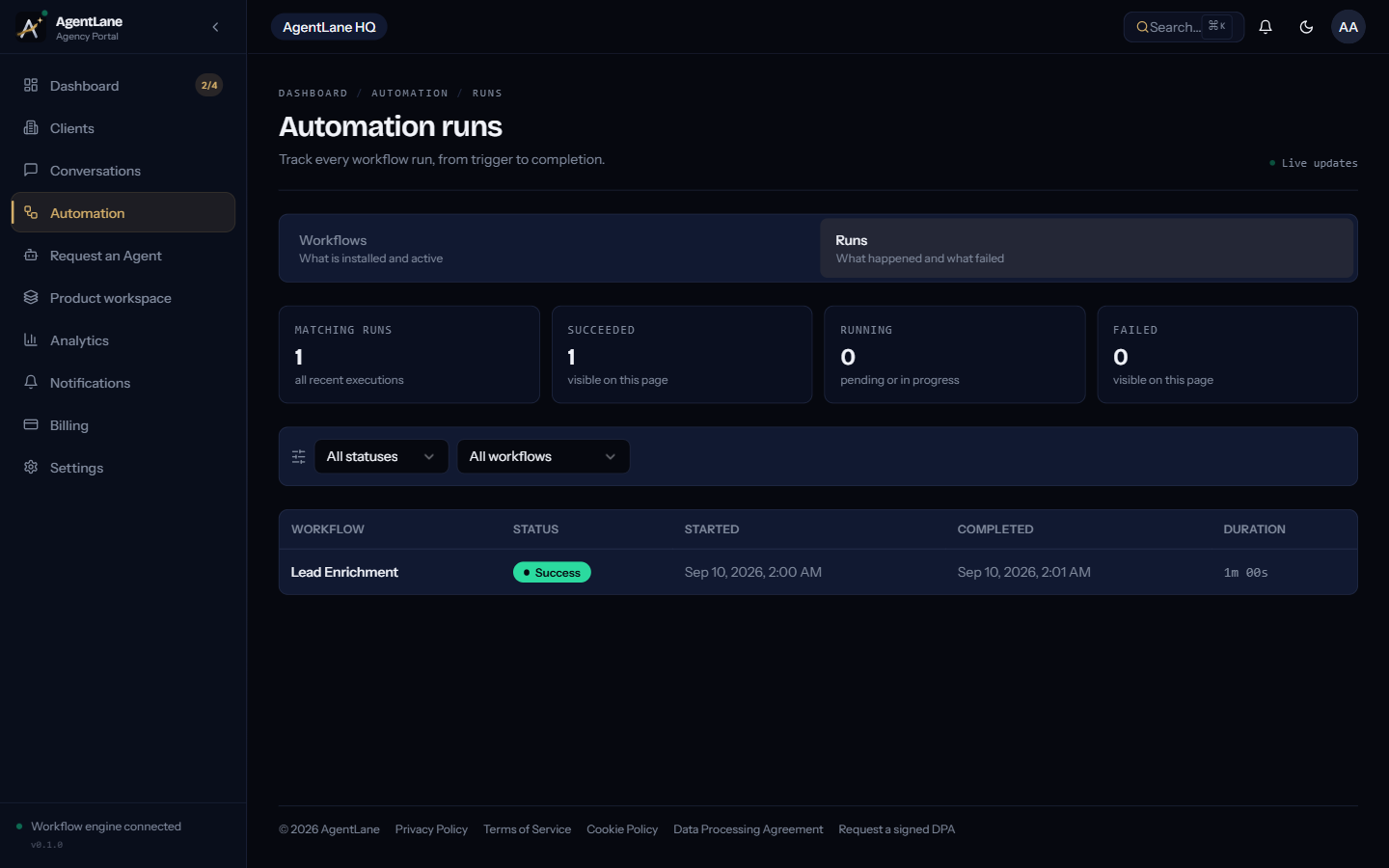
That feed is the thing to watch during the first heatwave after go-live — it's where you'll see whether the urgency branch is actually catching the no-cooling calls or letting them fall into the routine queue.
Sizing it for one HVAC company
The same arithmetic that works for any missed-call problem applies here, with one seasonal wrinkle: run it separately for peak weeks and off-peak weeks, because the inputs genuinely differ.
| Input | Peak week source | Off-peak week source |
|---|---|---|
| Calls per day | Phone log during first heatwave week | Phone log on an ordinary week |
| % missed or unanswered | Same log | Same log |
| Average job value | Recent invoices | Recent invoices |
| Close rate on answered calls | Bookings ÷ calls taken | Bookings ÷ calls taken |
The general version of that math, worked through with a plumbing example, is in our missed-call text-back piece — the formula is identical, HVAC just multiplies the "calls per day" input by three or four for a handful of weeks a year, which is exactly when an unattended answering system earns its keep.
Where to start
Pull your own call log from the last heatwave or cold snap, not an average week — that's the number that tells you whether this is worth building before the next one hits. If HVAC is one of several trades you serve, the same Lead Qualifier setup covers plumbing and electrical dispatch without changes to the underlying mechanics — see how it's actually deployed or book a consultation and bring last summer's call data with you.
Figures on off-hours call timing are ServiceTitan's own aggregated platform data, linked below — I did not find a comparably rigorous public source for HVAC missed-call rates specifically, so I've left that number out rather than repeat one of the many uncited figures circulating in HVAC marketing content.
Sources:
Frequently asked questions
- Does Lead Qualifier actually support HVAC?
- Yes — Home Services is a real industryFit tag on AgentLane's Lead Qualifier agent, not an aspirational one. HVAC, plumbing and electrical all sit inside that tag; the agent's mechanics (AI qualification, Cal.com availability, email follow-up) don't change by trade.
- Will it try to diagnose the HVAC problem itself?
- No, and it shouldn't be built to. It collects what the caller can describe — no cooling, no heat, a smell, a leak — and hands that context to a technician. Diagnosis over the phone from an untrained caller's description is a bad idea whether a human or an AI is doing it.
- What happens to overflow it can't book same-day?
- It should offer the next real available slot rather than pretending same-day capacity that doesn't exist. A caller who can see an honest two-day wait and takes it is a booked job. A caller told 'someone will call you back' with no time attached usually isn't.
- Does this replace dispatch software?
- No. It sits in front of it — the agent qualifies and books into the calendar your dispatcher already uses, it doesn't replace routing, technician assignment, or parts logistics.
- How fast can one HVAC company actually get this live?
- A configured Lead Qualifier agent, using an existing price list, hours and Cal.com link, is typically live within 24 hours — see the deploy walkthrough for the full sequence.