Law Firm Intake Automation: Qualifying Enquiries Without Giving Legal Advice
The hard part of automating law firm intake isn't the qualification logic — it's the line between routing an enquiry and creating an attorney-client relationship. Here's where that line sits and how to build to it.
By AgentLane Founder · Founder
Automating law firm intake is a narrower job than it looks. The scheduling and triage mechanics are the same as any consultation-booking business. The part that requires real care is the boundary: the agent collects facts and routes the enquiry, and the assessment of whether someone has a case — the actual legal advice — stays with an attorney, every time, with no exception.
Law firm intake has a well-documented capacity problem, and it's worth establishing the size of that before getting into what's safe to automate around it.
How much intake capacity does a law firm lose?
More than most firms assume, and it's measured, not anecdotal. Clio's Legal Trends Report — the most cited primary research source in this industry, built from data across thousands of firms on its own platform — found that only 52% of law firms either answer the phone or return a missed call, meaning roughly 48% of firms are functionally unreachable by phone for a first-time caller. On the email side, only 33% of firms respond to a prospective client's message at all, down from 40% a few years earlier — and 23% of firms never respond to an inbound enquiry in any channel.
For the firms that do respond, speed is inconsistent: average response time runs past 8 hours for phone enquiries and 24-plus hours for web-form submissions. Firms using dedicated intake technology, by contrast, report meaningfully higher lead volume and revenue in the same report — which tracks with the general pattern of every response-speed study in this space, not a legal-specific finding.
None of that capacity gap requires an AI to solve — a hired intake coordinator solves the same problem. What automation changes is coverage: a firm that can't staff a phone at 9pm on a Sunday, when a prospective client is searching for a lawyer after being served papers, can still catch that enquiry.
Where the real boundary is
Every U.S. state has unauthorized-practice-of-law statutes that prohibit a non-lawyer — and by extension, software acting on a firm's behalf — from providing legal advice or services. Multiple bar guidance documents, including the North Carolina Bar Association's 2026 guidance on AI policy and the American Bar Association's Center for Innovation resources on AI, are explicit that a chatbot or automated intake tool assessing a caller's legal position, or answering "do I have a case" with anything beyond "an attorney will review that with you," crosses from intake into the practice of law itself.
The disclosure requirement runs alongside it: guidance across multiple bar associations converges on the same expectation, summarized well in a 50-state AI-and-ethics survey published by Justia — a caller needs to be told plainly, early, that they're talking to an automated system and not a licensed attorney. Trying to disguise that is both an ethics problem and a practical one: it's the fastest way to turn a routine intake into a bar complaint.
None of this is a reason to avoid automating intake. It's a reason to be precise about what "intake" means here. A well-scoped agent stays entirely inside routine, non-legal territory:
What routes to a human, always, no threshold:
- Any question about whether a specific set of facts amounts to a viable claim
- Any request for an opinion on likely outcome, timeline, or settlement value
- Anything touching an active deadline or statute of limitations
- A caller in visible distress, or describing an emergency (a restraining order need, an imminent eviction, a criminal arrest)
What the agent can handle inside its own lane:
- Collecting the same intake-form facts a paralegal would ask for — names, dates, what happened, in the caller's own words — without characterizing them
- Sharing fee structure and process information the firm has already published (contingency vs. hourly, what a free consultation covers, typical next steps)
- Triaging by stated practice area so the right attorney's calendar gets offered, not a generalist guess
- Scheduling the consultation itself, with a live calendar
The distinguishing feature of every item in the first list is that it requires judgment applied to facts — the exact thing "legal advice" means. The second list is administrative, and staying inside it is what keeps an intake agent on the safe side of every bar-association guidance document cited above.
How that maps to a real deployment
Legal is a genuine industryFit tag on AgentLane's Lead Qualifier agent, listed alongside dental, home services, healthcare and several other consultation-booking verticals — the underlying mechanics (AI qualification, Cal.com availability, email follow-up) are identical to any other deployment of that agent. What changes for a law firm is entirely in the configuration: the prompt has to be written to qualify and triage without characterizing a caller's legal position, and the pre-approved content it's allowed to quote has to be limited to fee structure and process, not case assessment. That's the same branching pattern our deep-dive on how Lead Qualifier's scoring actually works covers in general terms — for a law firm, the "declined" and "needs a human" branches simply carry more weight than usual.
Every qualified enquiry, and the automated reply it received, should be visible in the same conversation log any Lead Qualifier client sees — which matters more for a law firm than most verticals, because a firm's own malpractice carrier or bar counsel may reasonably want to see exactly what an automated system said to a prospective client:
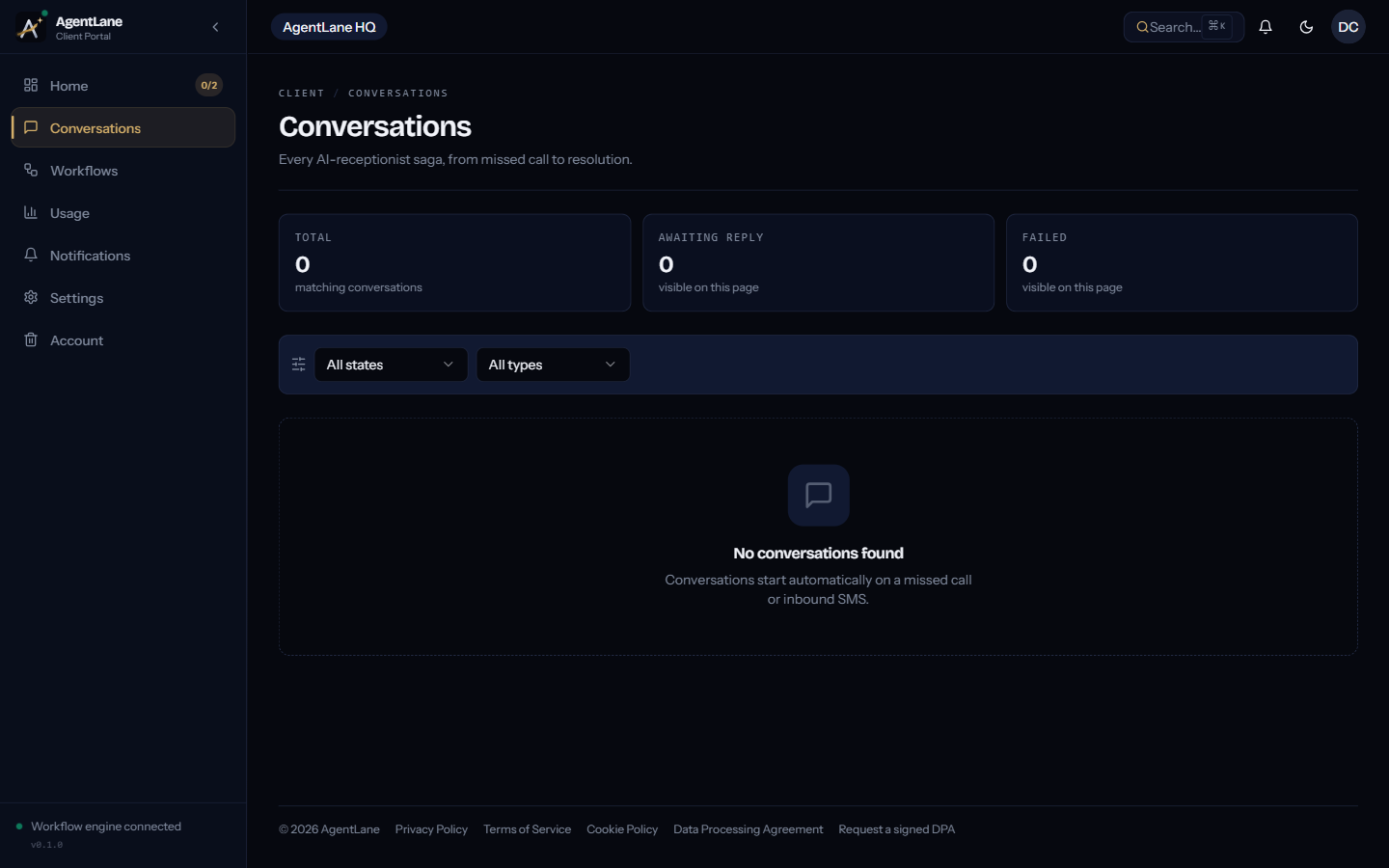
That log, combined with the cross-client executions feed covered in Monitor & Debug, is the record a firm should be able to produce if a bar complaint or a malpractice question ever turns on what the automation actually said.
What to raise before launch, not after
Talk to the firm's malpractice carrier and bar counsel first. This is not a step to skip because the mechanics look identical to any other Lead Qualifier deployment — the content is what's different, and a firm's own carrier is better placed than a vendor to say what its specific coverage requires.
Write the disclaimer into the first message, not buried in a footer. "I'm an automated assistant, not an attorney — nothing here is legal advice" belongs in the opening exchange, plainly stated.
Keep the practice-area triage conservative. A caller describing a criminal matter routed to a family-law consultation slot is a worse outcome than no automation at all — when the practice-area match is ambiguous, default to a person rather than a guess.
Review transcripts periodically, not just on complaint. A spot-check of the automated exchanges catches drift in what the agent is saying before it becomes a pattern worth worrying about.
Where to start
If your firm — or your agency's law-firm client — is losing intake capacity to unanswered calls and unreturned messages, that's worth measuring against Clio's own benchmark numbers before building anything. From there, see how a Lead Qualifier agent gets deployed, and raise the compliance questions above with your own bar counsel as part of that setup, not after it's live. Or book a consultation and we'll walk through where the automation boundary sits for your specific practice areas.
I'd rather this post talk you out of automating something you shouldn't than help you automate it faster. The compliance sourcing above is bar-association and primary-research material, linked directly — treat this as a starting point for a conversation with your own counsel, not a substitute for one.
Sources:
- Clio — Legal Trends Report press release on client-inquiry response rates
- North Carolina Bar Association — Beyond the Ban: Why Your Law Firm Needs a Realistic AI Policy (2026)
- American Bar Association — Center for Innovation, Artificial Intelligence issues
- Justia — AI and Attorney Ethics Rules: 50-State Survey
Frequently asked questions
- Is 'Legal' a real industryFit tag on AgentLane's Lead Qualifier, or a stretch?
- It's a real, published tag — listed alongside dental, home services, healthcare and several other consultation-booking verticals. The agent's mechanics don't change for legal; what changes is how carefully the qualification prompt and pre-approved response content have to be written.
- Can the agent tell a caller whether they have a case?
- No. Assessing the merits of a legal matter is legal advice, and it requires an attorney's judgment applied to a specific set of facts. The agent's job stops at collecting what the caller is willing to share and routing it to someone who can make that assessment.
- Does using an AI intake agent create an attorney-client relationship?
- It shouldn't, if it's built correctly — and firms should not assume that by default. The disclaimer language, what the agent is and isn't permitted to say, and where confidentiality begins are questions worth raising with the firm's own malpractice carrier and bar counsel before launch, not assumptions to bake in silently.
- What can it actually automate, then?
- Scheduling a consultation, collecting the facts an intake form would ask for anyway, answering questions about fees and process that are already published on the firm's website, and triaging by practice area — none of which requires evaluating a case.
- How is this different from a general Lead Qualifier deployment?
- The booking mechanics are identical to any other Lead Qualifier deployment. What's different is the content the agent is permitted to say and the disclosures it has to make — that's a configuration and prompt-writing discipline specific to a regulated-advice context, not a different product.