The Real Math Behind Reselling an AI Receptionist as a Marketing Agency
A client just asked about missed calls and chatbots. Here is how the white-label margin actually works, what to watch for in an infrastructure partner, and how to size it before you say yes.
By AgentLane Founder · Founder
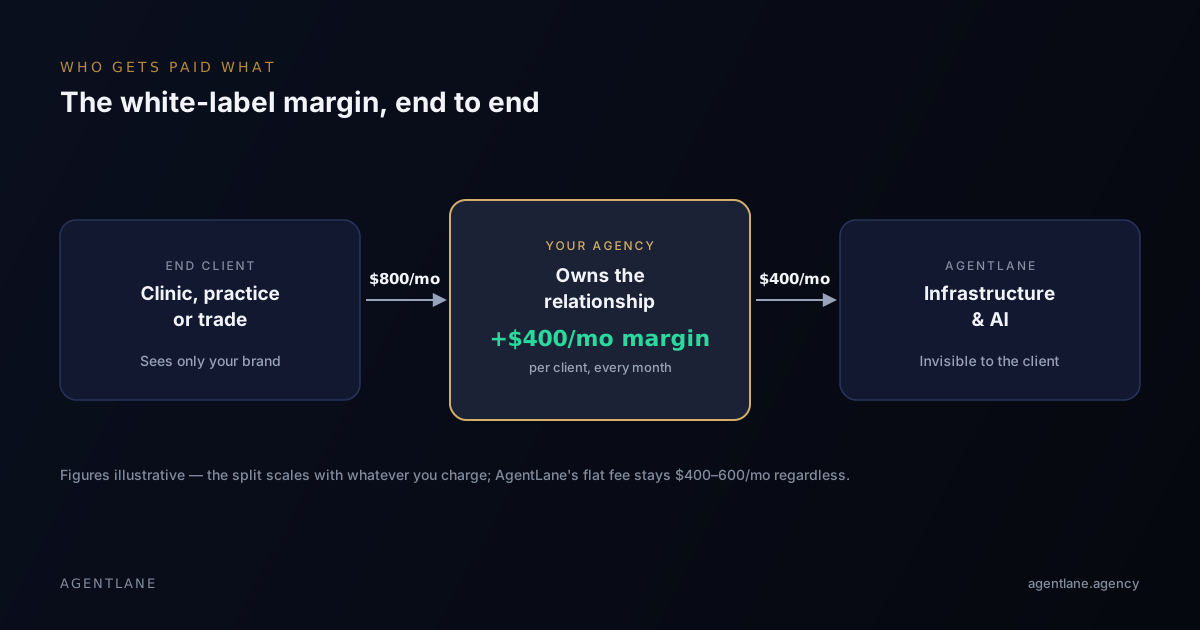
Reselling a white-label AI receptionist works the same way any white-label service works: the end client pays your agency under your brand, you pay the infrastructure partner a flat monthly fee, and the difference is your margin. AgentLane's own fee is $199–$249/month per client depending on your plan tier, whatever you charge on top of that.
Every agency that builds websites and runs ads for local businesses eventually has the same conversation. A client mentions they're losing bookings to missed calls, or asks if you can "add one of those AI chatbot things." You have two options: build it, or find someone who already has and put your name on it.
This covers how the money actually moves, what determines whether it's worth doing for your agency, and what to check before you pick who you white-label from.
Why building it yourself is usually the wrong first move
The instinct for a capable agency is to build it in-house — you already run technical projects, so why not this one? The honest answer is that a missed-call automation is not one tool, it's several stitched together: a programmable phone number, a language model that can hold a real conversation, a calendar integration that actually books instead of just suggesting, and an escalation path for anything the AI shouldn't handle alone. Bolting three SaaS tools together gets you something that mostly works until the day it doesn't, and you're now the one supporting the integration — not selling websites and ads.
The alternative is running it behind your brand instead of inside your stack: one isolated instance per partner, provisioned once, billed to you at a flat rate you mark up however you like.
How the money flows
The diagram at the top of this article shows the shape of it. The structure has three parties and one direction of visibility: the end client only ever sees your agency. AgentLane's fee is $199–$249/month per client, set by your agency's plan tier — the range shown as ESTIMATED_MONTHLY_COST in the request-agent dialog itself, not a marketing estimate — regardless of which of the four catalog agents you deploy for them, flat within your tier. Bill the client $700–$900 a month and you're holding roughly $500–$700 as recurring margin, for as long as they stay; bill less and the margin shrinks accordingly, since your own cost side doesn't move.
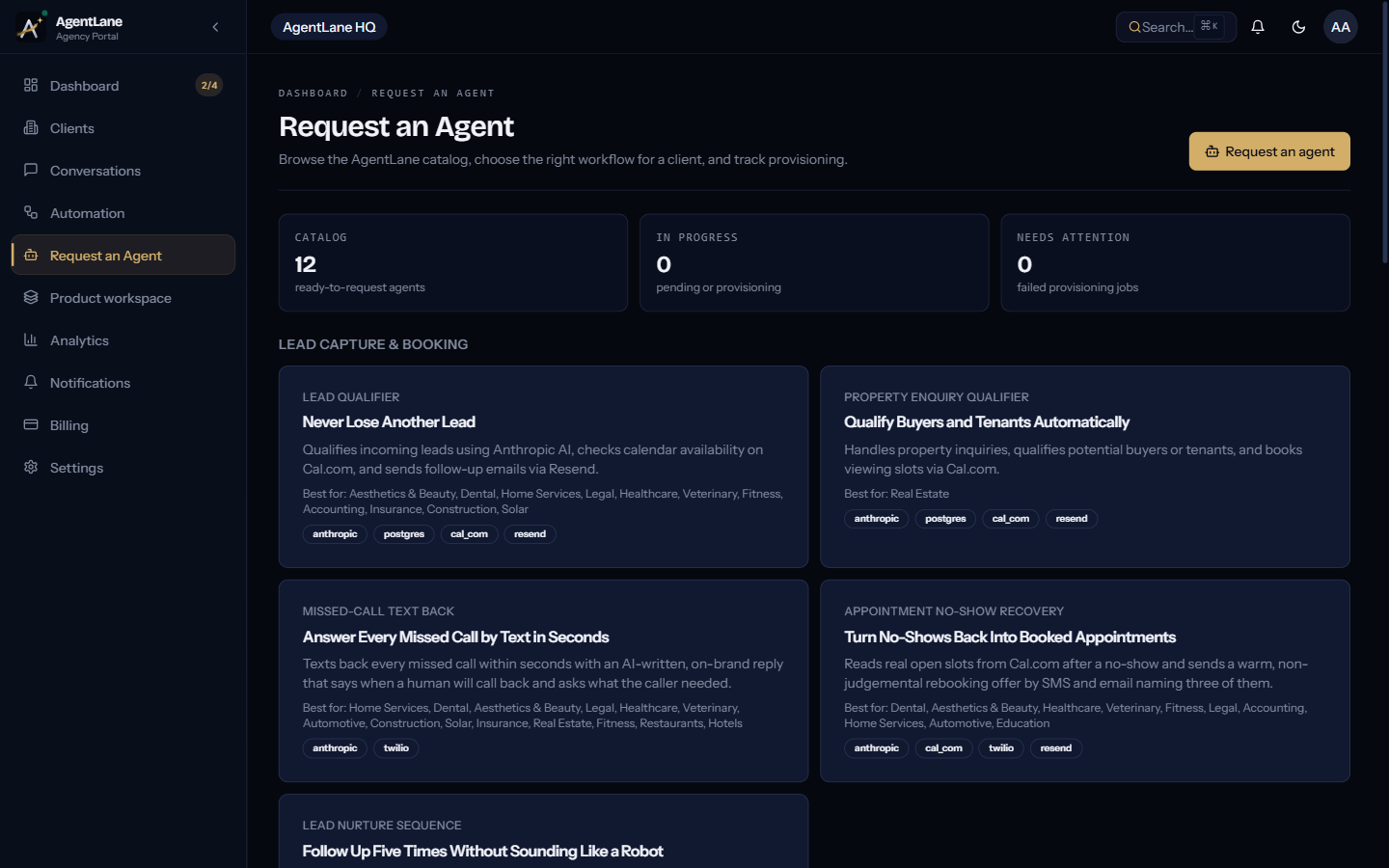
Full current pricing for your own agency plan — separate from what you charge the end client — is on the pricing page.
Two things make this different from a typical software resale arrangement worth calling out:
The infrastructure partner should be invisible. Not "white-labeled" in the sense of a logo swap — genuinely absent from anything the end client sees: the SMS sender name, the voice on the phone, the weekly report you forward. If a partner's product still shows through anywhere, that's your agency's credibility attached to someone else's brand by accident.
The margin is per client, not per seat. There's no license tier to negotiate as you add clients — the economics of client five look the same as client one, which is what makes this scale without a corresponding growth in your own overhead.
What determines whether this is worth doing for your agency
The math is simple once you have the two numbers that matter: how many of your existing clients plausibly lose bookings to missed calls or slow response, and what margin you can hold at a price they'll accept. Multiply clients by monthly margin and that's the recurring revenue line — the part that's easy to underestimate is how little of your own time it costs per client after the first one. Onboarding client five is not meaningfully harder than onboarding client one; the process is the same five inputs and the same day-one turnaround.
The real cost to your agency isn't engineering time — you're not building anything. It's the same sales and relationship time you'd spend introducing any new service, applied to a service your clients are already asking about.
What to check before you pick a partner
No lock-in beyond a short notice period. Thirty days is a reasonable standard. Anything requiring a long-term commitment before you've proven it with a single client shifts the risk onto you before you've had a chance to test it.
A real Data Processing Agreement, not a verbal assurance. Your clients' customer data is flowing through this — you should be able to hand your client a signed DPA if they ask, not "we'll get back to you."
A direct line to the people who built it. A generic support ticket queue is fine for a SaaS tool you configure yourself. For something answering your client's phone as their business, you want the people who built the agent reachable directly when something needs to change fast.
A dashboard you can actually run the business from, not just a login. Client records, credential storage, a live execution feed, and billing all in one place — see the Partner Dashboard reference for what that surface looks like at AgentLane specifically, so you know what to compare a partner against.
A pilot, not a contract. Any partner asking you to commit a client list before you've run a single real pilot is asking you to underwrite their sales risk with your own client relationships. One client, one trial period, is the right size for a first test.
Where to start
Pick one client who has already mentioned missed calls, slow response, or asked about automation. That is the pilot — not a hypothetical portfolio rollout, one real client whose call flow you can walk through and size honestly.
Check pricing against what you'd charge that client, then book a free consultation if the numbers work for you.
I run this exact white-label programme, so the $199–$249 range above is our own published rate, not an industry benchmark — check it against whatever you're evaluating.
Frequently asked questions
- Do we need any technical skill on our team to sell this?
- No. You sell the outcome — fewer missed calls, more booked appointments — and the infrastructure partner handles the phone number, the AI configuration and the calendar integration. Your team owns the client relationship, not the plumbing.
- What happens if a client asks a technical question we can't answer?
- That should go straight to the infrastructure partner's technical team, not sit in a support queue. A direct channel — Slack is the common pattern — with the people who actually built the agent is what keeps a technical question from turning into a client-confidence problem.
- How fast can we get a first pilot client live?
- With five basic inputs — business name, services, prices, hours and a calendar link — a configured agent is typically live within 24 hours. That is fast enough to pilot with a real client rather than a demo account.
- Do we set our own price to the client?
- Yes. The infrastructure partner invoices you a flat rate; what you charge the client, and therefore your margin, is entirely yours to set.
- What happens if we want to stop?
- With a reasonable partner, thirty days' notice ends it — conversation history exported, phone number released, no further obligation. If a partner's exit terms are vaguer than that, treat it as a real red flag before you sign anything, not after.
- Is there a minimum number of clients to start?
- There shouldn't be. The sensible way to evaluate this is one pilot client, not a portfolio commitment — you are testing whether the product holds up with a real client before deciding whether to sell it to the rest of your list.