AI Intake for Aesthetics Clinics: Consultations, Pricing Questions and No-Shows
Aesthetics intake is dominated by three repeat problems — pricing questions before anyone has a consultation, no-shows on the calendar, and after-hours enquiries. Here's what AI intake actually changes about each one.
By AgentLane Founder · Founder
Aesthetics and med-spa intake has a narrower shape than most verticals: the same handful of pricing questions on repeat, a meaningful share of booked consultations that don't show up, and enquiries that arrive well outside a front desk's hours. AI intake changes each of those three things differently — not with one generic fix.
A dental front desk juggles insurance verification, check-in, and the phone at once. An aesthetics front desk has a different problem: a small number of very repetitive questions ("how much is Botox," "do you have anything today," "what's the difference between filler and Botox") arriving constantly, competing with an in-person consultation that's already underway. The fix looks similar to other intake automation on the surface, but the actual leverage points are specific to this vertical.
The three problems, and what changes about each
Pricing questions before anyone has booked anything
Most inbound enquiries to an aesthetics clinic are price-shopping, not booking-ready. A caller asking "how much is lip filler" isn't usually asking for a consultation slot yet — they're deciding whether to call the next clinic on their list. Answering that instantly, with whatever price range the clinic has approved for the AI to quote, keeps the enquiry in the conversation instead of losing it to the next search result. Getting that answer wrong or leaving it unanswered for hours has the same effect either way: the caller moves on.
This is the one part of the flow that maps directly onto the Services field every Lead Qualifier deployment already uses:
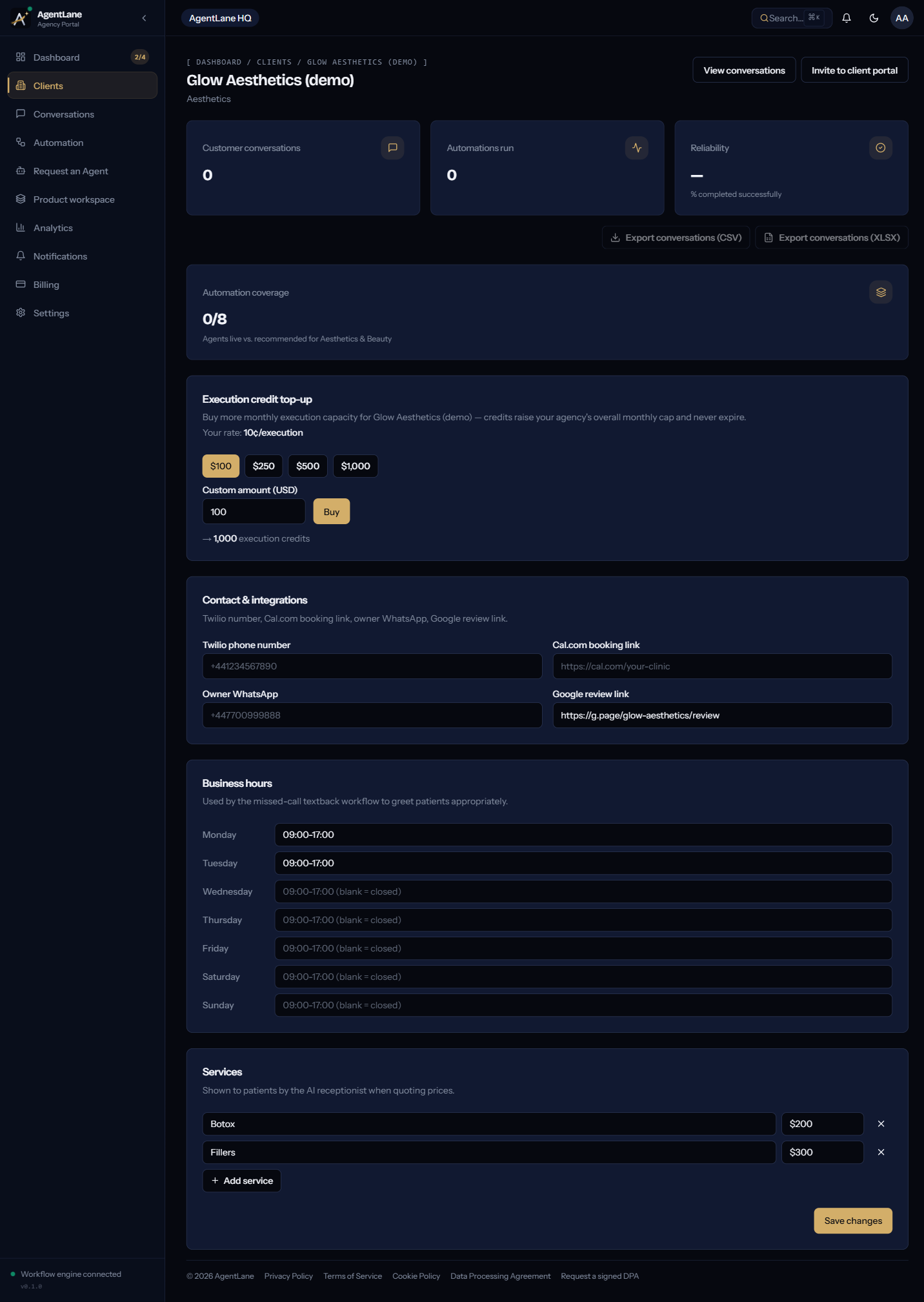
Whatever's listed there is what the agent can quote. A clinic that only stocks a stale price list gets stale answers back — this is worth treating as clinical setup, not an afterthought.
No-shows on the calendar
This is the claim worth being precise about, because the numbers circulating in aesthetics marketing content are inconsistent to the point of being close to useless. A lot of vendor blogs cite a med-spa no-show rate somewhere between 15% and 25%, often without a named source. The one number in this space that comes from an actual measured dataset rather than a marketing estimate is Zenoti's 2025 Beauty and Wellness Benchmark Report, built from real booking data across more than 30,000 salons, spas and med spas in the US and Canada — which puts medspas at roughly a 5% no-show rate and an 8% cancellation rate, the highest no-show figure among the business types it measured, but nowhere near the 15–25% range you'll see quoted elsewhere.
The honest read: no-shows are a real, measurable cost in this vertical, and they're worse for aesthetics than for the average beauty or wellness business in the same dataset — but the specific size of the problem is smaller, and better documented, than most of what gets repeated about it. Size your own clinic's actual no-show rate from your booking software before treating any external number as your baseline.
What AI intake changes here isn't the no-show rate directly — it's what happens around it. A same-day cancellation can be offered to a waitlist within minutes instead of sitting empty until someone notices, and a booking confirmation that arrives instantly, with a clear reschedule link, reduces the ambiguous "did I actually book that" no-shows that have nothing to do with intent and everything to do with a confirmation that never quite landed.
After-hours and mid-treatment enquiries
The front desk is often doing check-in or supporting an injector mid-treatment when the phone rings. That's the same missed-call dynamic covered in general terms in our dental practice piece — a call that goes unanswered is rarely a callback opportunity for long, it's a caller trying the next clinic. Aesthetics has a sharper version of that problem than most verticals, because so many enquiries are price comparisons across two or three nearby clinics rather than a single committed choice.
How the qualification branches
Aesthetics fits AgentLane's Lead Qualifier agent on its real, published industryFit list — not a category stretched to cover it. A scored enquiry branches three ways, the same shape as our walkthrough of exactly how that scoring works:
- A clear consultation request with realistic fit → offered a real slot from the live Cal.com calendar and booked automatically.
- A price-shopping enquiry that isn't ready to commit → answered with the approved price range and a nurture follow-up, not pushed into a booking it isn't ready for.
- Something ambiguous, or a clinical question about suitability → handed to a person rather than guessed at.
Every branch posts a Slack alert to the clinic's team, so a receptionist coming off a treatment can see what came in and what was already handled without scrolling through a voicemail box.
What it does not attempt
Suitability for a specific treatment, contraindications, or anything requiring a licensed provider's judgment stays a consultation, full stop — the agent's role ends at getting a qualified enquiry onto the calendar for one. It also does not attempt to verify insurance or medical history; aesthetics is mostly self-pay, and what verification exists belongs to intake paperwork completed at the clinic, not a pre-booking chat thread.
Where to start
Pull your clinic's actual no-show rate and your five most-asked pricing questions from the last month — those two things, not an industry average, determine whether this is worth setting up and what it needs to be able to answer on day one. From there, see current pricing or deploy a Lead Qualifier agent using the same walkthrough any consultation-booking business follows.
Aesthetics clinics come up often in agency partner conversations specifically because the pricing-question volume is so repetitive — this piece is built from that pattern, not a single client's numbers. The no-show figures above are linked to their original source.
Sources:
Frequently asked questions
- Is Aesthetics & Beauty a real industryFit tag, or a stretch?
- It's a real tag on AgentLane's Lead Qualifier agent. The mechanics — AI qualification, live Cal.com availability, email follow-up — apply to any consultation-booking business, and aesthetics clinics are named explicitly alongside dental, home services and several other verticals.
- Can the AI quote a treatment price?
- It can share whatever price list the clinic has pre-approved it to quote — the same Services field used for any Lead Qualifier deployment. It should not attempt to price a bespoke treatment plan; that stays a consultation.
- Does it reduce no-shows on its own?
- Not by itself. What it changes is the quality of the confirmation and reminder loop around a booking, and the speed of rebooking a cancellation slot before it goes empty. Deposit policy and reminder cadence still matter more than the channel delivering them.
- Will it try to give medical advice about a treatment?
- No — and it shouldn't be built to. Anything about suitability, contraindications or expected results for a specific person's skin or medical history routes to a consultation with a licensed provider, not a chat thread.
- How is this different from a generic booking widget?
- A booking widget shows open slots to someone who already knows what they want. This reads a free-text enquiry — 'how much is lip filler' or 'do you do anything for acne scarring' — qualifies it, and only then offers a slot, which is most of what an aesthetics front desk actually spends its time on.