How to Price AI Automation to a Local Business Client
Start from the real $199–$249/month cost of one agent for one client, then build a client price around a margin target instead of a guess — worked through as a three-tier pricing worksheet.
By AgentLane Founder · Founder
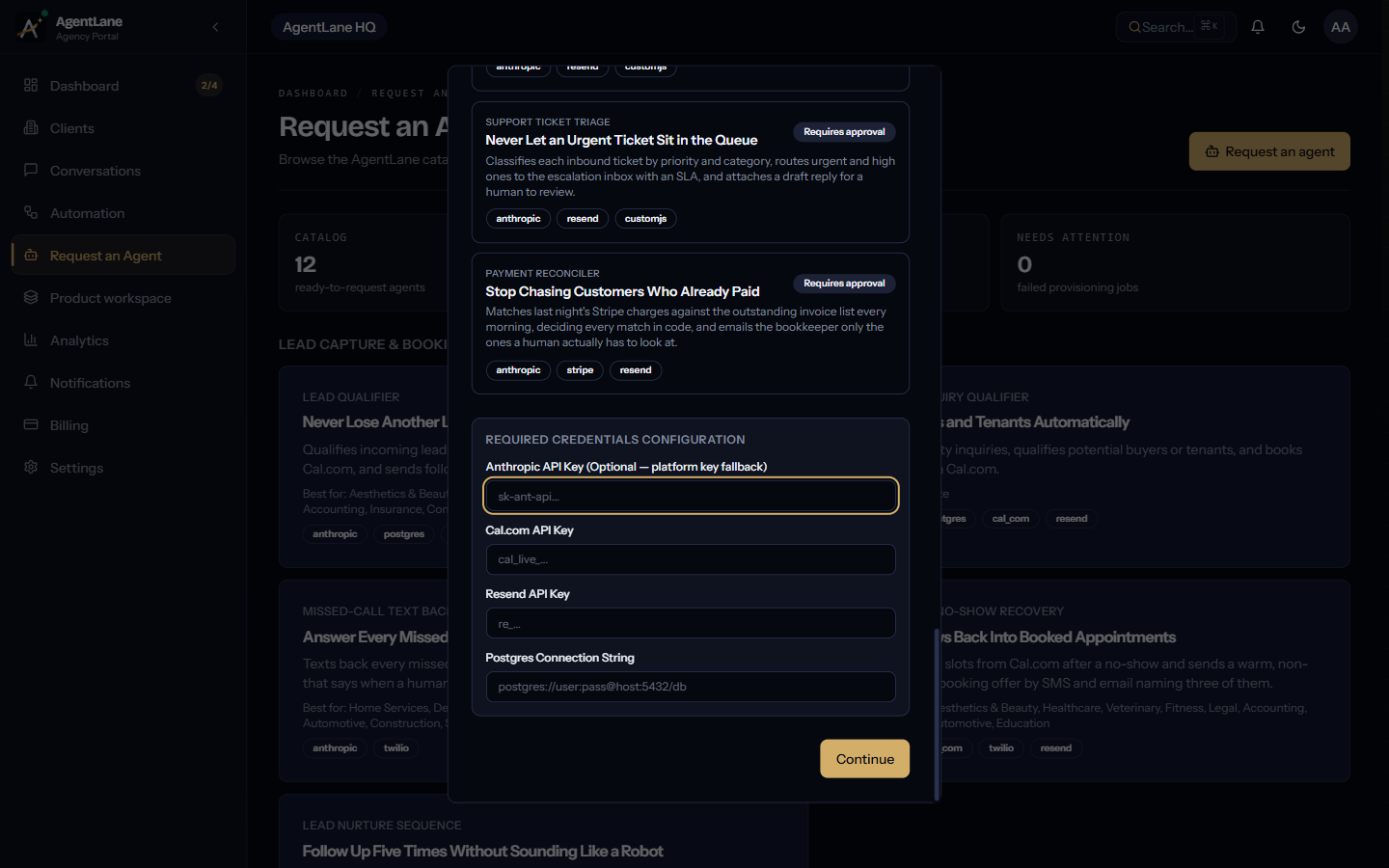
The honest way to price an AI automation to a client starts with your real cost, not a number you've seen a competitor charge. AgentLane's own flat cost is $199–$249/month per agent, per client, set by your agency's plan tier — the range shown in the product's own Request an Agent dialog, not a marketing estimate — and every pricing decision from there is really a margin decision layered on top of that fixed floor. This worksheet uses $199/month, the rate on AgentLane's Scale tier, as its worked example; swap in your own plan's figure.
This is a worksheet, not a rate card. It walks through the arithmetic in three tiers so you can land on a number for your own client, rather than copying someone else's.
Start with the number that doesn't move
Whatever else changes, your cost for a single AgentLane agent instance is flat for your plan tier: $199/month in this worksheet's example, the same whether the client's phone rings five times a day or fifty. That figure is shown directly in the product's own cost-estimate step when you request an agent — not an estimate, the literal number the dialog displays for your plan.
That flat floor is the one input in this worksheet you don't have to estimate. Everything else — what the client is willing to pay, what margin you're comfortable holding, whether to price per agent or bundle — is a judgment call, and this post is about making that judgment deliberately instead of by instinct.
Tier one: the floor price (breakeven, don't stop here)
At minimum, your client price has to clear $199/month plus whatever of your own time goes into the relationship — onboarding, occasional check-ins, being the person the client calls when something feels off. Call that time cost a nominal $50–100/month for a client you're not actively firefighting, which puts a genuine floor somewhere around $249–300/month just to avoid losing money on the account.
Pricing at the floor is a mistake agencies make when they're anchoring on "what does this cost me" instead of "what is this worth to them." A floor price with no margin above it means every hour spent on that client is unpaid time the moment anything goes wrong — a Twilio hiccup, a client question, a credential that needs resetting. Treat the floor as the number below which you shouldn't go, not a target.
Tier two: the margin-anchored price
This is the number worth actually using, and it's built from the client's side of the equation, not yours. Ask what the automation is actually recovering for them — a missed-call flow, for instance, has a direct arithmetic version of this in the missed-call text-back math: calls per week × miss rate × average job value × close rate gives a real weekly opportunity figure, even before applying a conservative recovery discount.
Once you have that number, price as a fraction of the value recovered, not a markup on your own cost. A client whose missed calls represent even a conservative $1,000/month in recoverable job value can comfortably support a $700–$900/month price — which nets your agency $500–$700/month in margin on a $199 cost, and is still a fraction of what the automation is worth to them.
| Client's estimated monthly recoverable value | Reasonable client price range | Your margin on a $199 cost |
|---|---|---|
| $500–$1,000 | $600–$750 | $400–$550 |
| $1,000–$2,000 | $750–$950 | $550–$750 |
| $2,000+ | $950–$1,200+ | $750–$1,000+ |
These bands aren't a rate card to copy verbatim — they're a starting frame. The point of the table is the relationship: price scales with the client's own upside, and your margin grows with it, rather than your margin being a fixed markup regardless of how much value the automation is actually generating for that specific business.
Tier three: the multi-agent client
The one detail worth knowing before you quote a client on more than one agent: AgentLane charges the full $199/month (or your plan's rate) for a client's first agent, and halves the fee for each additional agent on that same client. A client running both a Lead Qualifier and a Google Reviews Responder costs your agency roughly $300/month total, not $400 — see the pricing-model breakdown for the full detail on how that stacking works.
That gives you real room on a bundled quote. If a single-agent client is priced around $750–$900/month per the table above, a two-agent client doesn't need to be priced at double that to hold a healthy margin — your own cost isn't doubling either. A bundled quote somewhere around 1.6–1.8x the single-agent price, rather than a flat 2x, still expands your margin in absolute terms while giving the client a visible discount for buying more from you.
Putting the worksheet together
- Confirm your cost. $199–$249/month per agent, per client depending on your plan tier, flat within that tier — check the current figure against the pricing page since the base rate is admin-configurable.
- Estimate the client's recoverable value, using their own numbers where you can get them — call logs, review response times, quote turnaround — not an industry average.
- Anchor the price to that value, in the range of roughly 1.5–2.5x your cost depending on how strong the recoverable-value case is.
- Adjust for a multi-agent bundle, using the halved-fee discount your own cost gets, passed through partially rather than entirely, to keep the bundle margin-positive for you.
- Hold the price. Because your own cost is flat regardless of the client's call volume, there's no cost-side reason to re-price them upward as the automation succeeds — which is a genuinely good thing to be able to say to a client asking whether their bill goes up if it works.
If you haven't done the arithmetic for a specific client yet, the missed-call text-back post has the exact formula for estimating recoverable value from a real call log. Once you've settled on a number, book a free consultation if you want a second read on it before you send the quote.
The $199 figure used throughout this worksheet is AgentLane's own Scale-tier rate, quoted directly from our product ($199–$249 across the self-serve tiers) — not an industry estimate. The pricing tiers built on top of it are ours to suggest, not to guarantee for your specific market.
Frequently asked questions
- What's a reasonable starting margin target?
- There's no universal number — it depends on your market and what the client would otherwise spend on a missed opportunity. The worksheet in this post starts from your real cost ($199–$249/month per agent, per client, by plan tier) and works forward to a price, rather than starting from a guessed client price and hoping the margin is fine.
- Should I price per agent, or bundle multiple agents into one number?
- Either can work, but be deliberate about it. AgentLane halves its own per-agent fee for a client's second agent on the same client, so a two-agent client costs your agency less than double — bundling into one client-facing number can reflect that without you having to explain the discount structure to the client.
- What if the client pushes back on the price?
- Go back to the arithmetic that justified the number in the first place — what a missed call, an unanswered review, or a slow quote turnaround is actually costing them, not what the automation costs you. A price anchored to their own upside survives a negotiation better than one anchored to your cost.
- Does the price need to change if the client's call volume grows?
- Not under AgentLane's flat-rate model — your own cost stays fixed per agent, per client regardless of volume, so there's no cost-side pressure to re-price a client as they get busier. That's a genuine advantage over usage-metered vendors, worth stating plainly if a client asks.