White-Label AI Receptionist Pricing: What Agencies Actually Pay Per Client in 2026
Per-minute, per-seat, per-conversation, or flat-rate — the four ways white-label AI receptionist pricing actually gets structured, and the arithmetic behind each one.
By AgentLane Founder · Founder
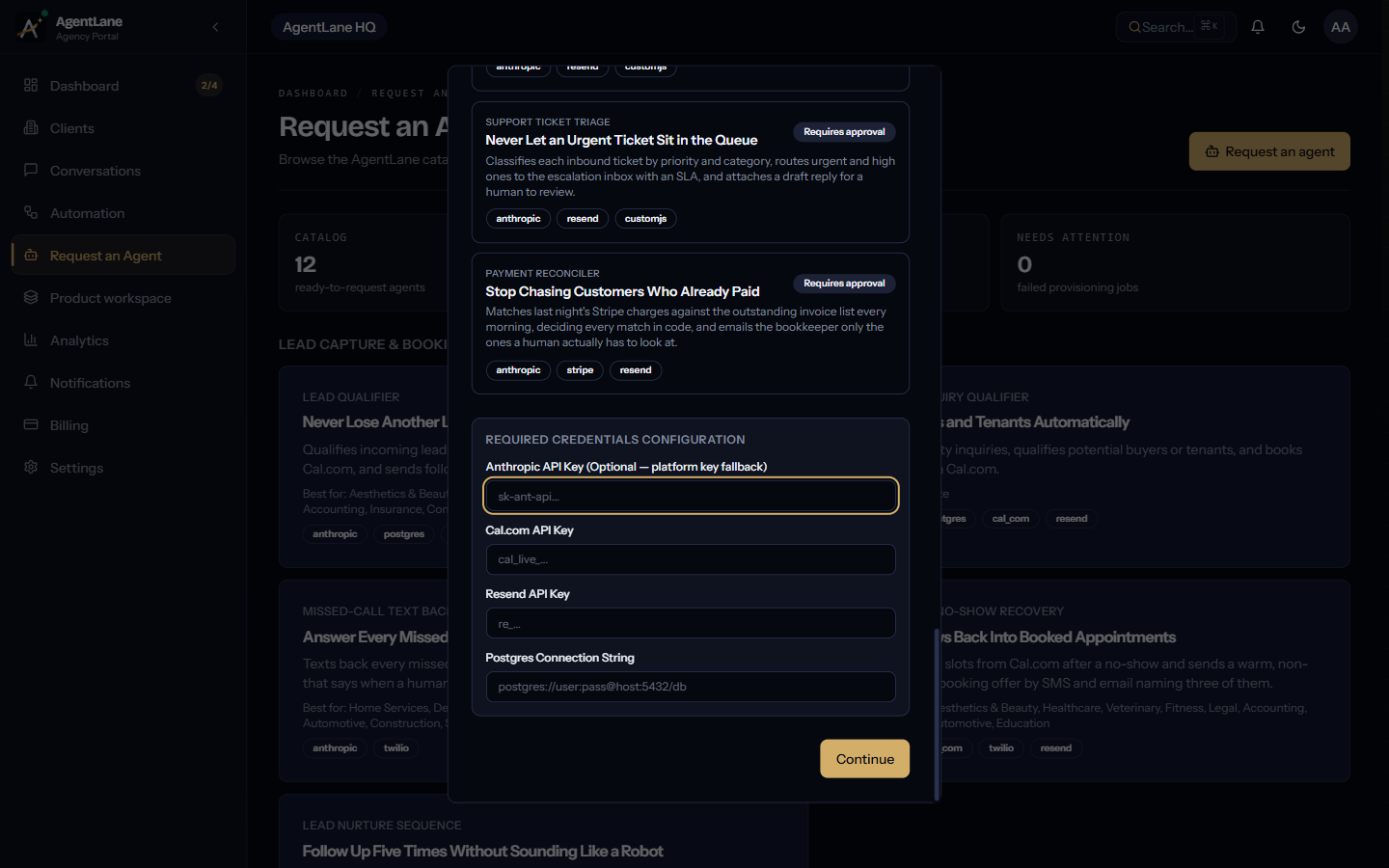
AgentLane charges agencies $199–$249/month per agent, per client — the exact figure set by your agency's plan tier, flat regardless of call volume, conversation count, or which of the four catalog agents you deploy. That range isn't a marketing estimate — it's what the product's own Request an Agent dialog shows. The rest of this market prices differently, and the difference changes how predictable your margin is more than it changes the headline number.
If you're evaluating a white-label AI receptionist to resell, the pricing model matters as much as the price. Four models show up repeatedly across this category. Here's what each one actually does to your invoice.
The four pricing models, side by side
| Model | How it's metered | What happens to your margin as usage grows | Where it shows up |
|---|---|---|---|
| Flat rate per client | One fee per active client, regardless of usage | Fixed — your cost is the same whether the client gets 5 calls or 500 | AgentLane's own model: $199–$249/month per agent, per client, by plan tier |
| Per-minute | Billed on call or conversation duration | Variable — a busy month costs the agency more, which either erodes margin or has to be passed to the client | Common in voice-AI and call-center-style vendors |
| Per-seat | Billed per staff user with dashboard access, not per client served | Can undercharge on a client-heavy, staff-light agency, or overcharge a small team serving many clients | Common in general SaaS/CRM platforms with AI bolted on |
| Per-conversation | Billed per distinct chat/call thread | Similar variability to per-minute, just counted differently | Common in chatbot-first platforms |
This is a directional description of how the market typically prices, not a claim about any specific competitor's current rate card — vendors change pricing often enough that a specific number quoted here would be stale before this post is edited again. The structural point holds regardless of the exact figures: usage-based pricing ties your cost to your client's success in a way that's good for the vendor's margin and unpredictable for yours.
The arithmetic that matters to an agency
Say you're pricing a missed-call automation to a client at $750/month — a reasonable mid-range figure for a local-service business that's losing real bookings to missed calls, and your agency is on AgentLane's Scale tier at $199/agent-client.
Flat-rate model: Your cost is $199/month, full stop. Your margin is $551/month, every month, whether the client gets 40 calls or 400. You can forecast this line on a spreadsheet a year out and be right. (On a lower-volume tier your cost runs up to $249/month instead — still a fixed number, just a different one.)
Usage-based model, same client: If the vendor charges, say, $0.35/minute and the client's AI receptionist handles 300 minutes of calls in a strong month (which is exactly the outcome you sold them on — more calls answered, not fewer), your cost is $105 that month. A slow month might be $30. That's not necessarily worse economics on average — it might even be cheaper in a quiet month — but it means your own margin moves every billing cycle, and you either eat the swing or re-quote the client, neither of which is a good conversation to have repeatedly.
The practical difference: flat-rate pricing lets you set a client price once and hold it. Usage-based pricing means either you re-price periodically (friction with the client) or you hold your price and absorb the variance (friction with your own margin).
What the flat rate includes
AgentLane's $199–$249/month (by plan tier) covers a fully configured, monitored agent instance for one client — not a per-call or per-token metered add-on you have to track. The four catalog agents (Lead Qualifier, Google Reviews Responder, Property Enquiry Qualifier, Quote & Proposal Generator) all bill at this same rate; see the agent catalog for what each one actually does before you decide which to lead with. Your agency's own plan — seats, included executions, whether AI tokens are bundled into the base fee or billed BYOK — is a separate line, covered on the pricing page, and it's worth checking both numbers together before you quote a client.
The detail most agencies miss: stacking agents on one client
That figure is what you pay for a client's first agent. Under the hood, AgentLane halves the per-agent fee for each additional agent deployed on the same client — so a client running Lead Qualifier and Quote & Proposal Generator together doesn't double your cost. That matters because a two-agent client (say, lead qualification plus automated review responses) is a realistic upsell, not an edge case, and it's worth knowing the second agent doesn't erase the margin you built on the first.
What to ask a white-label vendor about pricing before you sign
Is the number in front of you the whole number, or a floor? A "starting at" price that excludes telephony, AI tokens, or a per-minute overage isn't comparable to a genuinely flat fee until you've added those back in.
What happens on a high-volume month? Ask this directly rather than assuming. A vendor with usage-based pricing should be able to tell you, in real numbers, what a busy client actually costs in their worst recent month — not just the advertised floor.
Does the price change by which agent you deploy? If a vendor's "AI receptionist" and "review responder" are priced differently, your margin math has to be redone per agent type, which is one more thing to get wrong at scale.
For a full worked example of what the margin looks like once you've picked a price to charge the client, see the margin math post.
Where to go from here
If flat, predictable per-client pricing is the model you want to build your agency's margin on, check current plan tiers on the pricing page, then walk through deploying your first agent to see exactly what a client onboarding looks like before you quote anyone.
Sources:
- AgentLane's published rate card (/pricing) — the Request an Agent dialog shows your own plan's exact per-agent fee, read from the plan itself.
Pricing models in this category shift often enough that I'd rather point you at how to evaluate one than hand you a competitor number that's wrong by the time you read this — the $199–$249 range is ours, quoted from our own product, not an estimate of anyone else's.
Frequently asked questions
- Is $199–$249/month the total cost, or is there anything on top?
- It's the per-agent-client fee AgentLane charges your agency for a client's first agent — the range shown in the Request an Agent dialog's cost-estimate step, which one figure applies depends on your agency's plan tier. Your own agency plan (seats, included executions, whether AI tokens are bundled) is billed separately; see /pricing for current tiers.
- Does the price change by agent type?
- No. Lead Qualifier, Google Reviews Responder, Property Enquiry Qualifier, and Quote & Proposal Generator all bill at the same rate per client for your plan tier. You're not paying more for a more complex agent.
- What happens if a client uses a second agent?
- AgentLane charges the full per-agent-client fee for a client's first agent and halves the fee for each additional agent on that same client. A client running both Lead Qualifier and Google Reviews Responder doesn't cost your agency two full fees — check current figures against /pricing, since the base rate depends on your plan tier and is admin-configurable.
- Why do some competitors price per minute or per conversation instead of flat?
- Usage-based pricing scales the vendor's own compute and telephony costs directly to what a client actually consumes, which protects their margin on a high-volume client. The tradeoff lands on you: your own invoice to the client becomes unpredictable exactly when the automation is working best — i.e., handling more calls.