Property Enquiry Automation for Estate Agents: Qualifying Buyers and Booking Viewings
A walkthrough of AgentLane's Property Enquiry Qualifier agent — how it scores a buyer or tenant enquiry, matches it against your listings, and books a viewing, branch by branch.
By AgentLane Founder · Founder
AgentLane ships a purpose-built agent for this exact job — the Property Enquiry Qualifier — and it's had essentially no coverage on this blog until now. This post is the walkthrough: what it actually does with an inbound enquiry, how it matches against real listings, and where the three branches send a lead.
Property enquiries have a shape most lead-qualification tools don't account for: a buyer or tenant rarely wants "a property," they want one that matches specific, changeable criteria — bedrooms, budget, location, move-in date — against a listings inventory that changes weekly. A generic lead-qualifier that scores intent and books a call misses the part that actually matters for real estate: whether anything on the books fits.
What the agent does, branch by branch
The flow starts the same way any inbound-enquiry automation does — a webhook fires when a buyer or tenant submits an enquiry — and then does something the general-purpose version of this pattern doesn't: it queries the agency's own listings data before deciding what to do next.
Webhook (enquiry) ──► Score Enquiry with Claude ──► Parse Claude Response
                                                             │
                                                             ▼
                                                Match Properties (Postgres)
                                                             │
                                                             ▼
                                            Combine Enquiry + Matches ──► Log Enquiry
                                                             │
                                                             ▼
                                                          Switch
                             /                              │                            \
                  Qualified, matches found          Matches exist, not ready         No good matches
                          │                                  │                              │
              Cal.com: Get Available Slots         Email: Nurture Matches         Email: Decline Response
                          │                          Slack: Nurture Alert          Slack: Decline Alert
                  Find Earliest Slot
                          │
                  Book Cal.com Viewing
                          │
             Email: Booking Confirmation + Matches
             Slack: Match & Book Alert
That's the real, shipped flow — not a simplified version of it. Three things are worth calling out about how it branches, because they're the parts a generic lead-qualifier can't replicate:
A qualified buyer with a genuine listing match gets a viewing booked directly — the agent checks Cal.com for the earliest available slot, books it, and sends a confirmation email that includes the matched listings, not just a generic "we'll be in touch." The buyer sees exactly what they're viewing and when, in one message.
A lead who matches something in the listings table but isn't ready to view yet gets a nurture email with the matches attached, not a hard sell for a booking. This is the branch that separates a real estate qualifier from a simple booking bot — someone who says "just started looking, three to six months out" should get information to consider, not calendar pressure.
A lead with no realistic match in current inventory gets a polite decline. This is the branch worth paying attention to operationally: it means every enquiry that doesn't fit anything currently listed still gets logged and surfaced to the team, rather than silently dropped. An agency reviewing decline volume over time has a genuine signal for what buyers are asking for that the current inventory doesn't cover.
Every branch posts an internal Slack alert, so a team sees a match-and-book, a nurture, or a decline land in real time regardless of which one fires.
What "matching against listings" means, concretely
The step that makes this specific to real estate is Match Properties (Postgres) — after the enquiry is scored, the agent queries the agency's own listings table for anything that fits what the buyer described: bedrooms, budget range, location, and whatever else the enquiry text specified. This runs against real inventory data, not a fixed set of dropdown filters a buyer selects on a form. A buyer who writes "need at least 3 bed, garden, under $450k, close to the new school" gets matched against listings that actually satisfy that, not just tagged "3 bedroom."
What it requires, and what's honest to say about the industry tag
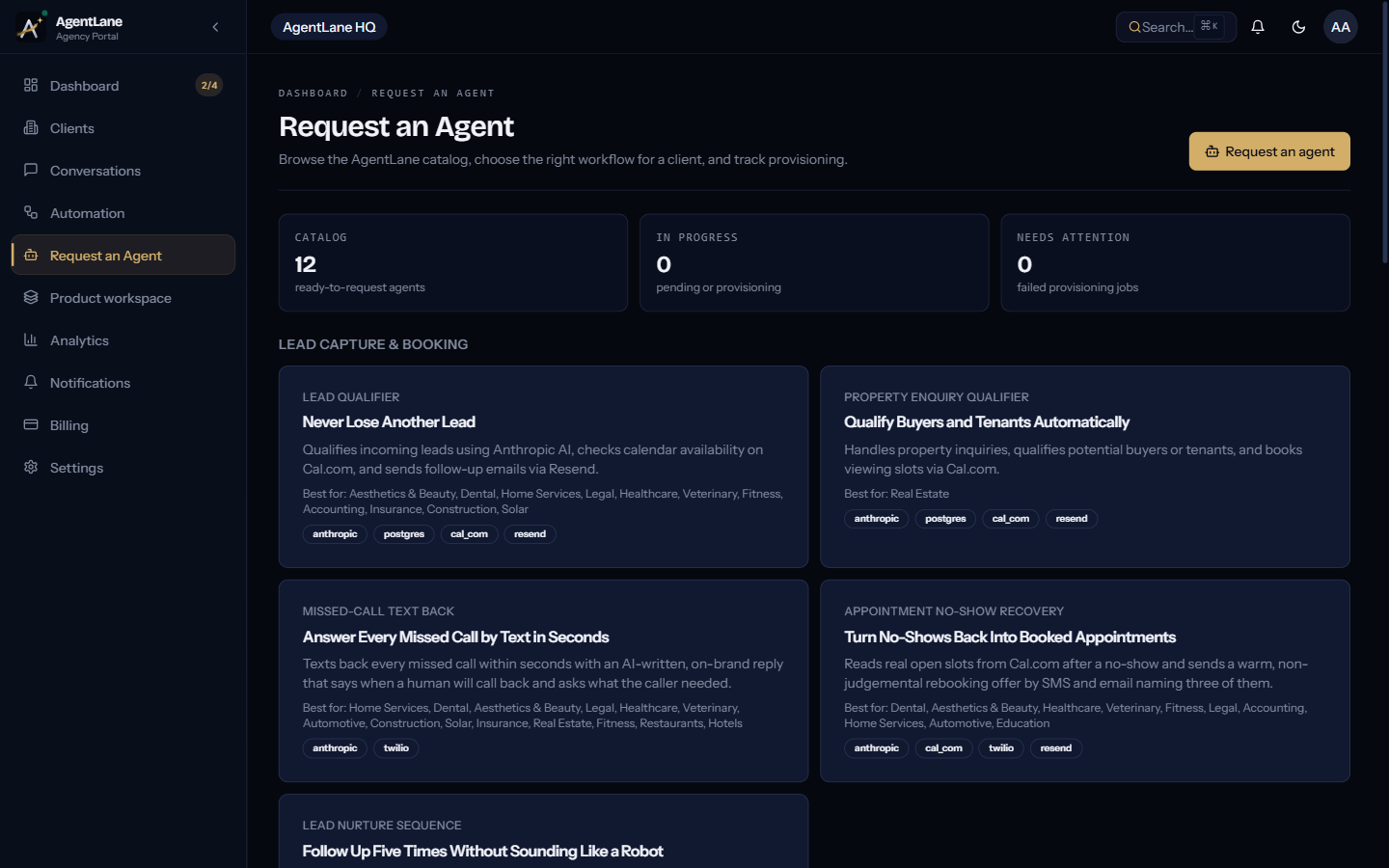
The agent needs four credentials to run: anthropic to score and qualify the enquiry, postgres to match against the listings table and log the enquiry, cal_com to book the viewing slot, and resend to send the confirmation, nurture, or decline email. It requires AgentLane staff approval before provisioning — unlike the instant-provision Lead Qualifier, this one goes through the same review dialog as any other non-instant agent:
Worth being precise about the industryFit tag itself: AgentLane's own agent documentation describes Real Estate as a taxonomy-only vertical today — no real-estate client has actually been provisioned on the platform yet, so the tag won't trigger a "Recommended" badge the way an industry with existing client outcomes would. That's a statement about how the catalog's badge logic works, not a hedge about whether the underlying agent functions — the flow above is the real, shipped mechanism, built and ready for the first agency that deploys it into this vertical.
A word on the response-speed statistics you'll find elsewhere in real estate marketing content: several widely circulated claims about "the percentage of buyers who go with whichever agent responds first" don't trace back cleanly to a verifiable primary source when you try to run them down, so this post isn't going to repeat one. What's not in dispute, and doesn't need a vendor statistic to justify it, is the basic mechanic: a buyer enquiry that sits unmatched and unanswered for hours is a buyer who has moved on to the next listing site by the time anyone replies.
How this relates to Lead Qualifier
If your agency already runs the general-purpose Lead Qualifier agent for other clients, the booking mechanics here will look familiar — same Cal.com availability check, same branching pattern, same Slack alerting. What Property Enquiry Qualifier adds on top is the listings-matching step, which is the part that makes it worth deploying separately rather than trying to bend Lead Qualifier's generic flow into a real-estate shape.
For an agency weighing whether to offer this under its own brand, the white-label economics are the same as any other catalog agent — a flat fee per client, marked up however the agency prices it, covered in our white-label margin breakdown.
Where to start
If you're an agency with an estate-agent client losing buyer enquiries to slow follow-up, or you run an agency yourself, see how a non-instant agent gets requested and provisioned — the request-dialog steps are the same ones this agent goes through. Or talk to us directly about being the first real deployment of this agent into the vertical it's actually built for.
Property Enquiry Qualifier is one of the least-covered agents in our own catalog relative to how complete it is — this post exists to close that gap, not to announce something new. The flow diagram above is reproduced from the agent's own reference documentation.
Frequently asked questions
- Is Real Estate a real industryFit tag, or a placeholder?
- It's real in the sense that matters — the agent genuinely does the work described in this post. Where it's honest to be precise: AgentLane's own docs describe Real Estate as a taxonomy-only vertical today, meaning no real-estate client has been provisioned on the platform yet, so it won't show a 'Recommended' badge tied to existing client outcomes. That's a statement about badge logic, not about whether the agent works.
- Does it write listing descriptions or run marketing?
- No. It only handles the inbound side — a buyer or tenant enquiry coming in, matched against your existing listings table, qualified, and either booked, nurtured, or declined.
- How does it match a lead to listings?
- It queries your own Postgres listings table directly after scoring the enquiry — bedrooms, budget, location and any stated must-haves from the enquiry text — rather than working from a fixed set of filters a caller has to select manually.
- What happens if there's no good match?
- It sends a polite decline rather than booking a viewing for a property that doesn't fit, and posts an internal Slack alert either way so your team sees every enquiry, not just the ones that convert.
- Does it replace an agent's judgment on a serious buyer?
- No — it handles first-contact qualification and calendar mechanics. Negotiating an offer, assessing a buyer's actual financing position, and closing stay entirely with the agent.