Can You White-Label n8n or Make.com for Clients? An Honest Answer
Self-hosting n8n or reselling Make.com per client sounds simple until you hit licensing, multi-tenancy, and maintenance reality. Here's an honest breakdown, plus how AgentLane's own isolation model actually works.
By AgentLane Founder · Founder
Agencies ask this question a lot, usually while sketching out whether they can build their own white-label AI automation business directly on top of an open-source workflow engine, instead of paying anyone else's margin. The honest answer: technically, partially, yes — but the licensing and multi-tenancy reality is more complicated than "just self-host it," and the complexity compounds specifically at the point where you have more than one or two clients.
The n8n path
n8n is open source and self-hostable, which makes "just run it yourself" sound simple. Two things complicate that for an agency specifically:
Licensing. n8n ships under its Sustainable Use License, which restricts using n8n itself to build a competing, hosted product you resell to third parties. Whether your specific agency model crosses that line depends on exactly what you're offering clients and how — this is genuinely a "read the current license text and probably talk to a lawyer" situation, not something a blog post should adjudicate for you. The distinction that usually matters: running n8n internally to power your own agency's automations is a different situation from reselling hosted access to an n8n instance as the product itself.
Multi-tenancy. n8n's open-source edition wasn't built as a multi-tenant SaaS platform out of the box — it's designed around one team's workspace. Serving multiple clients cleanly means either running genuinely separate instances per client (real infrastructure overhead: provisioning, patching, monitoring, and paying for each one separately) or building your own isolation layer on top of a shared instance (real engineering work that has nothing to do with the automation logic itself). Neither is impossible. Both are a second product you're now building and maintaining, on top of the automations you actually wanted to sell.
The Make.com path
Make.com (formerly Integromat) offers partner and reseller-oriented programs, and it's a genuinely more managed starting point than self-hosting n8n — you're not operating infrastructure yourself. What to check directly with Make.com before assuming it solves the white-label question fully: whether client-facing branding is genuinely invisible (not just a logo swap), how sub-account isolation actually works between your clients, and what happens to a client's data and access if you and Make.com part ways. These terms are the kind of detail that changes over time and should be verified against Make.com's current documentation, not taken secondhand.
What this costs an agency that goes the DIY route
Beyond the licensing question, the real cost is the same maintenance tail covered in the build-vs-buy post: once you're operating n8n instances (or Make.com scenarios) as a product rather than an internal tool, you own patching, uptime monitoring, credential security, and client-by-client debugging — permanently, not as a one-time setup cost. That's a real business to run, on top of the agency work you were trying to do in the first place.
How AgentLane's isolation model works — verified, not oversold
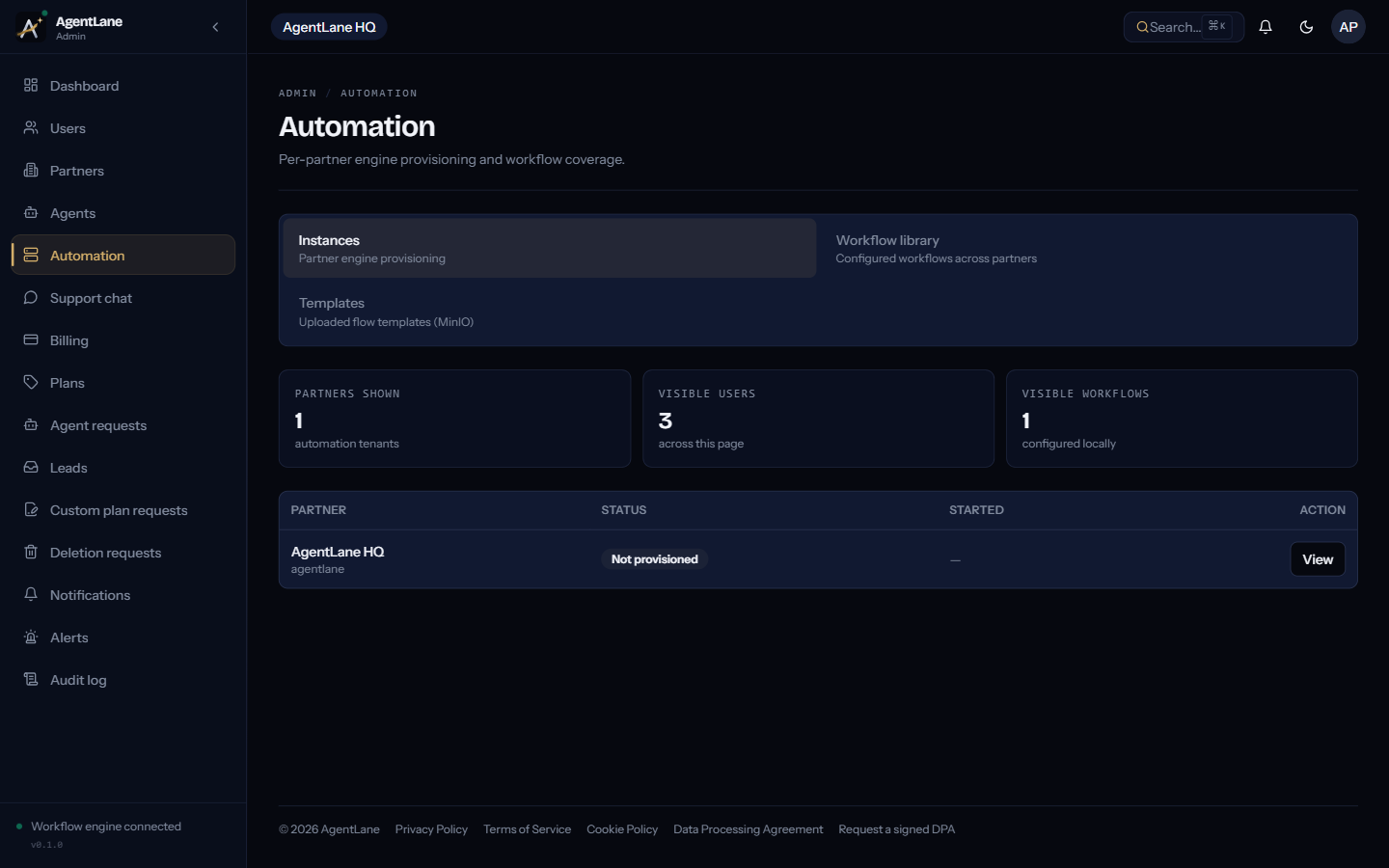
It would be easy to claim "every client gets a fully separate instance" here, and it wouldn't be accurate. What's actually true, per the Workflow Engine reference: isolation happens at the agency/partner level. Each partner agency that needs a dedicated setup goes through a tracked provisioning pipeline — historically a dedicated n8n container and database per partner, visible to AgentLane admins at /admin/automation/[partnerId].
The platform is migrating its engine to Activepieces, which runs shared-tenancy by default: one Activepieces deployment, with each partner agency getting its own project inside it rather than a fully separate container. Either way — n8n container or Activepieces project — the isolation boundary is the agency, not each individual end-client that agency serves. Your clients' agents run within your agency's provisioned instance or project, differentiated by client-specific configuration and credentials, not by separate infrastructure per client.
What that buys an agency is the part that actually matters for white-labeling: your clients never see AgentLane's own branding anywhere, your agency's data doesn't mix with another partner's, and you never touch n8n or Activepieces licensing directly — none of it is your problem to manage. See Deploy your first agent for what that looks like from a partner's side in practice.
The honest framework
Self-hosting n8n or building on Make.com directly is a real option if your agency has the engineering capacity to treat the licensing and multi-tenancy problem as its own project, separate from the automations you actually want to sell. If what you want is the automation business without also running the infrastructure business underneath it, that's the gap a white-label platform is built to close — worth being precise about what "isolated" actually means when you're evaluating one, rather than taking the marketing claim at face value.
Sources:
- n8n Sustainable Use License — the actual license terms governing self-hosted resale.
I looked up AgentLane's own isolation model against our Workflow Engine documentation before writing this, specifically because "every client gets their own instance" is the kind of claim that's easy to overstate — it's the agency that gets the dedicated instance or project, not each client inside it.
Frequently asked questions
- Can I just self-host n8n and give each client their own workflows?
- Technically yes, and plenty of agencies do exactly this. What's easy to underestimate is what happens after the first client: n8n's Sustainable Use License restricts reselling n8n itself as a hosted service to third parties, and running one instance per client (rather than shared workflows inside one instance) means you're now operating and patching a fleet of instances, not one.
- Does Make.com let agencies white-label it?
- Make.com has partner and reseller-oriented programs, but check their current terms directly before assuming full white-label — the specifics (client-facing branding, sub-account isolation, what a client is and isn't allowed to see) change over time and are exactly the kind of detail you shouldn't take secondhand from a blog post.
- Does AgentLane give every client a fully separate n8n instance?
- No — isolation happens at the agency/partner level, not the individual end-client level. Your agency gets a provisioned instance (historically a dedicated n8n container and database; a dedicated project inside a shared Activepieces deployment as the platform migrates to that engine), and your own clients run within that instance, distinguished by configuration rather than separate infrastructure per client.
- Is n8n licensing a solved problem if I'm just using it internally, not reselling it?
- Using n8n to run your own agency's internal automations is a different situation than reselling access to an n8n instance as a product to clients — the Sustainable Use License terms turn on what you're actually doing with it. Read n8n's current license directly rather than relying on a generic answer, since this determines whether your business model is compliant.