Workflow Engine
AgentLane is built to orchestrate powerful AI workflows without exposing any of that orchestration to Partners or Clients directly — they configure, AgentLane executes.
Activepieces is the production workflow engine
AgentLane uses Activepieces for the production catalog. Partners do not edit the underlying workflow engine directly: the Portal provisions the partner’s tenant, binds the required credentials, imports the catalog flows, and exposes the resulting status and execution history. Some internal or archived names may still mention the previous engine; those are implementation history, not a second supported provider.
We chose Activepieces as our engine because:
- Licensing — Activepieces offers an open-source-friendly license that aligns with AgentLane’s B2B2C reselling model.
- Developer experience — its TypeScript-based piece creation process lets us build custom, deeply integrated nodes for AI-specific use cases quickly.
- Scalability — the architecture scales horizontally to handle high-volume executions across thousands of end-clients securely.
Provisioning a partner’s instance
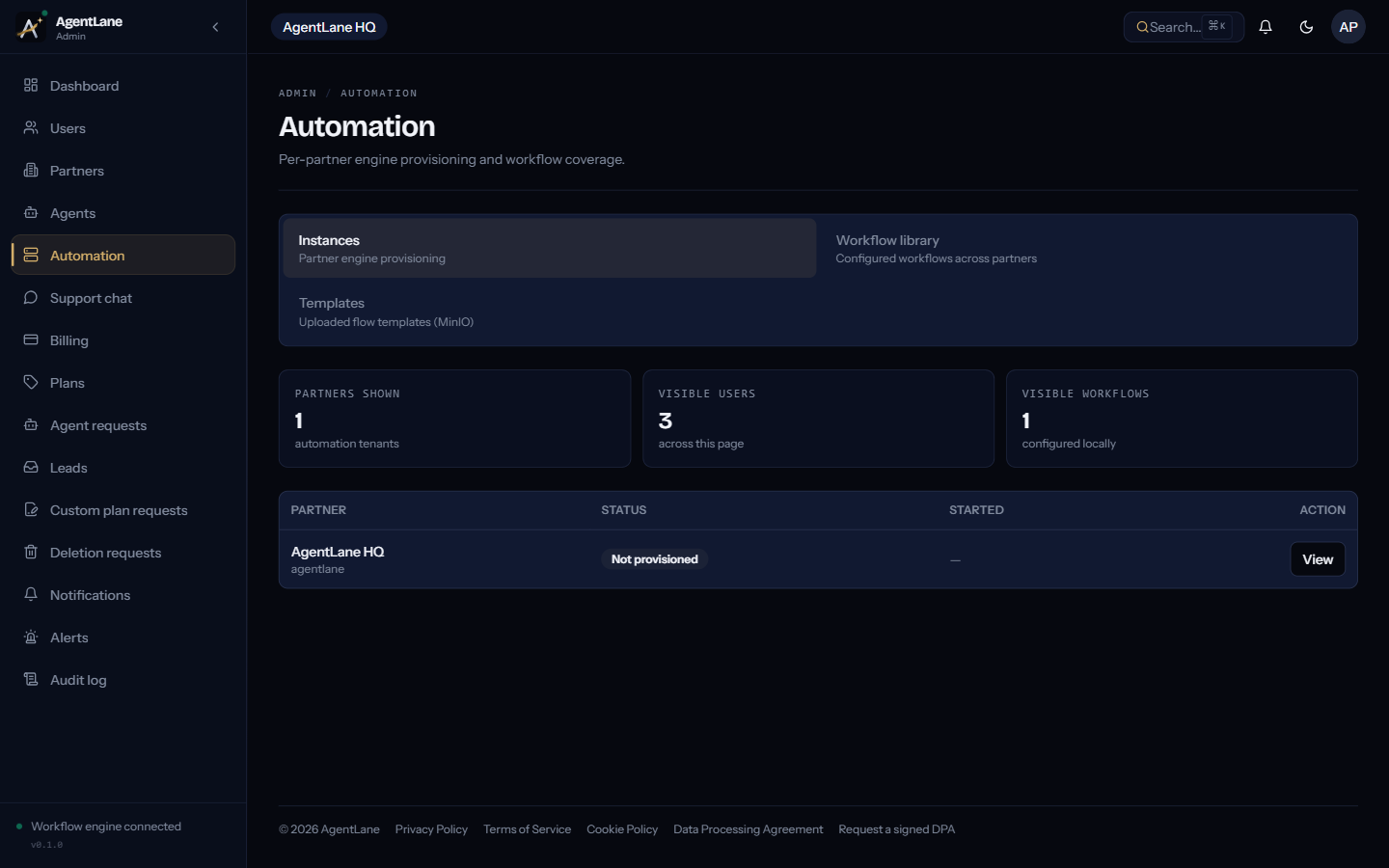
Each partner goes through a tracked provisioning pipeline, visible to Admins at
/admin/automation/[partnerId]. There is one Activepieces deployment in every tenancy mode; what
varies is whether the partner gets their own project inside it. See Activepieces Access &
Isolation for exactly what each mode isolates, and Admin:
Provision a partner for the operational walkthrough.
unprovisioned ──Provision──► provisioning ──► ready
                                  │
                                  └──failure──► failed ──Provision (retry)──► provisioning

ready ──Reprovision──► provisioning   (rebuilds the partner's Activepieces resources)
ready ──Deprovision──► unprovisioned  (permanent — cannot be undone)
Every attempt is broken into individually-timed pipeline steps, each recording success/failure, warnings, and both an internal error and a client-safe error message — so a partner-facing “provisioning failed” retry button never has to leak infrastructure detail, while Admins debugging the same failure see the full internal error and step timing. If a partner’s agent request (not the partner-level instance itself) fails to provision, see Troubleshooting → Provisioning failures for the specific errors that produces.
Provisioning an Activepieces partner
Activepieces runs shared-tenancy by default (AUTOMATION_TENANCY_MODE=shared) — there is one
Activepieces deployment and one shared project, and every partner’s flows live in it.
Separation between partners is enforced entirely by AgentLane’s own authorization checks plus
namespaced deterministic external IDs, not by an engine-level boundary. Setting
AUTOMATION_TENANCY_MODE=project instead gives each partner their own Activepieces project. The
Admin detail page shows tenancy mode, project ID, base URL, provisioning status, and the pipeline
steps for the latest attempt.
Provisioning runs synchronously per request: verify_connectivity → ensure_tenant (returns the
shared project, or resolves/creates a per-partner one) → bind_credentials (upserts each required
connection by deterministic externalId) → import_flows → verify_flows → enable_flows. An
unresolved credential fails the attempt rather than enabling a flow with a silent gap.
All twelve pipeline steps, the endpoint surface and who may call it, and the session-auth model are documented in Activepieces Access & Isolation.
How a request flows end to end
- Configuration — a Partner requests an agent for a client from
/dashboard/agents; once fulfilled, they configure client-specific values (Twilio number, Cal.com link, business hours, services) from that client’s detail page. See Deploy your first agent. - Trigger — an external event occurs (an inbound Twilio call, a missed call, a chat message) and hits the AgentLane API via webhook.
- Execution — the API injects the client-specific configuration and payload securely into the corresponding Activepieces flow on that partner’s provisioned instance or project.
- Logging — the engine returns the trace and result to AgentLane, which populates the Executions feed in real time and rolls the result up into that client’s usage counters and the agency’s Analytics dashboard.
Partners never author flows or nodes directly in an Activepieces UI — the Portal abstracts that complexity entirely, letting them deploy pre-built, pre-optimized agents just by filling out configuration forms and mapping credentials.