Connect Integrations
Every agent your agency deploys needs third-party credentials — an AI provider, Twilio, Cal.com, Resend, sometimes Postgres. You set agency-wide defaults once; individual clients can override any of them later without touching your own settings.
Open Settings → Integrations
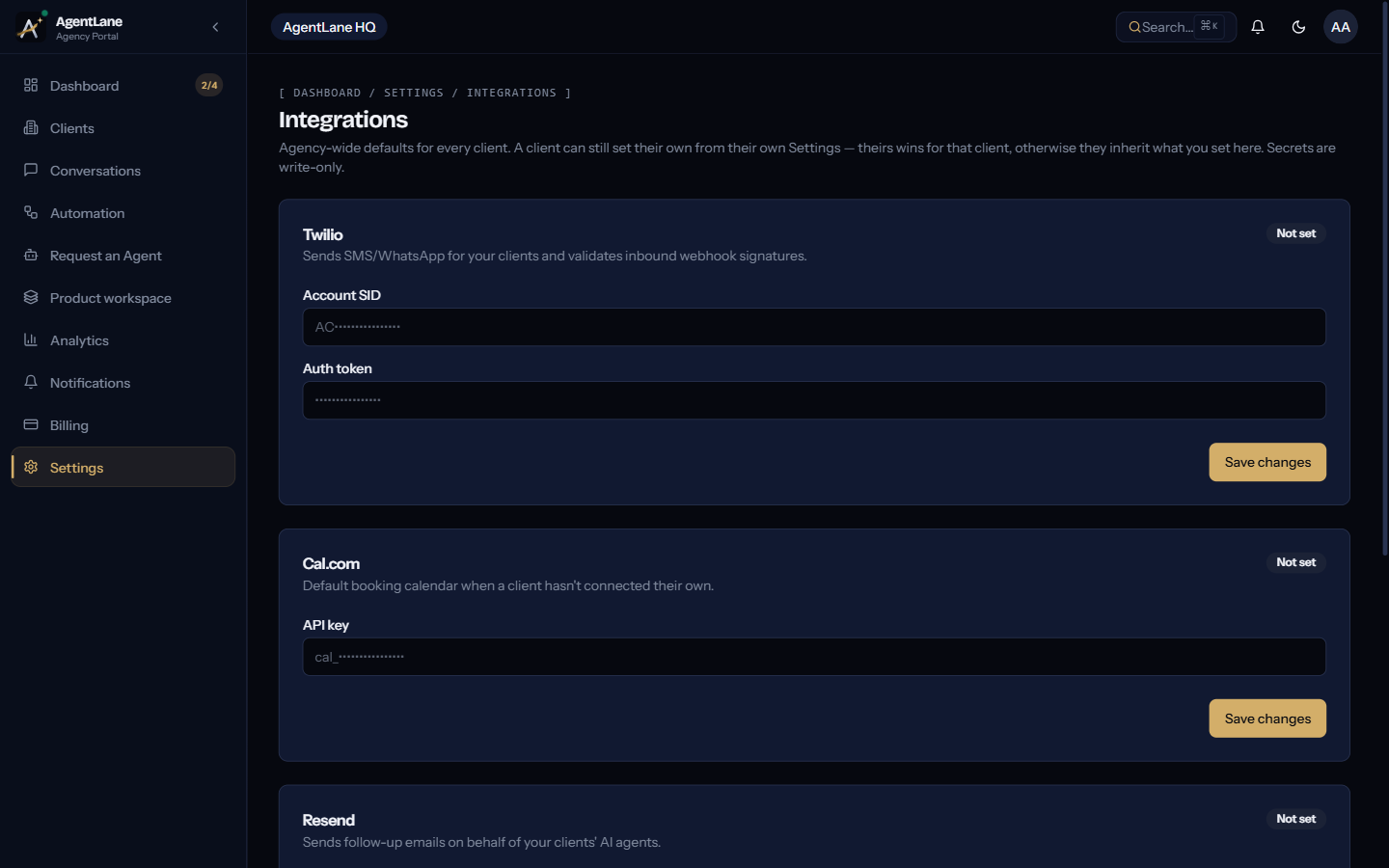
Go to /dashboard/settings/integrations. Each provider gets its own card.
Set your AI provider (skip on Managed AI)
If your plan doesn’t bundle AI tokens (i.e. you’re not on a Managed AI plan), set an Anthropic and/or OpenAI API key. On a Managed AI plan, these cards don’t appear at all — AgentLane’s own key is always used, and there’s nothing to configure.
Set Twilio, Cal.com, and Resend
- Twilio — Account SID and Auth Token. Sends SMS/WhatsApp on your clients’ behalf and validates inbound webhook signatures.
- Cal.com — an API key, used as the default booking calendar when a client hasn’t connected their own.
- Resend — an API key, used to send follow-up emails on behalf of your clients’ AI agents.
Set Postgres, if an agent needs it
Some catalog agents (e.g. Lead Qualifier) read/write client business data through a database — set a connection string here if you’re centralizing that at the agency level rather than per-client.
Configure your workflow instance
Below the credential cards, this page also shows your Activepieces workflow resources — either the configured endpoint or a full provisioning card if AgentLane manages the partner project. This section is hidden entirely on the Launch plan.
The credential waterfall
A credential resolves in this order, for a given client and provider:
- That client’s own credential — set from their own Settings → Credentials.
- Your agency-wide default — set here.
- AgentLane’s own platform key — but only for
anthropicandopenai, and only if neither of the above is set.
Every other provider (Twilio, Cal.com, Resend, Postgres) has no platform fallback — it must be BYOK at either the client or agency level, or the credential simply isn’t configured.
All secrets are write-only — once saved, they never round-trip back to the browser, even to you. For the exact REST routes and per-provider field shapes behind this page, see API Access → BYOK Credentials Vault.