White-Label vs. Reseller vs. Affiliate: Three Ways to Sell AI Automation, and Their Margins
Three genuinely different models for selling AI automation to your clients, with real tradeoffs on margin, brand control, and how much of the client relationship you actually own.
By AgentLane Founder · Founder
These three words get used almost interchangeably in agency marketing, and they shouldn't be — they describe genuinely different arrangements, with different margins and different amounts of the client relationship you actually control. Picking the wrong one for your agency's stage isn't a branding mistake, it's a margin mistake.
The three models, defined honestly
Affiliate. You refer a client to a vendor's product using a tracked link or code, and the vendor pays you a commission — usually a percentage of what the client pays, sometimes a flat referral fee. The vendor owns the entire client relationship: their brand, their support, their billing. You own the referral, and the recurring or one-time commission on it.
Reseller. You sell the vendor's product under a formal agreement, often at a wholesale price you mark up, and you handle at least some of the client-facing relationship — sales, sometimes tier-one support. The product itself may or may not carry the vendor's branding, depending on the specific agreement; "reseller" doesn't inherently promise the vendor is invisible, the way white-label does.
White-label. You sell the product entirely under your own brand. The vendor is structurally invisible to the end client — not just a logo swap, but absent from the sender name on a text, the voice on a call, the report you forward. You set the client price entirely yourself against a fixed wholesale cost from the vendor, and you own the full client relationship: sales, support, billing, and the brand the client associates the outcome with.
Where the margin differs
| Affiliate | Reseller | White-label | |
|---|---|---|---|
| Who sets the client price | The vendor | Often negotiable, sometimes vendor-set | You, entirely |
| Revenue structure | Commission, set by vendor | Markup on wholesale, per agreement | Markup on a fixed wholesale fee, entirely your call |
| Brand the client sees | The vendor's | Often the vendor's, sometimes co-branded | Yours, exclusively |
| Who owns client support | The vendor | Shared, per agreement | You, front-line |
| Upfront commitment | Usually none | Often a minimum volume or agreement | Usually a signup, sometimes a pilot |
| Ceiling on your margin per client | Fixed by vendor's commission rate | Set by contract, moderate flexibility | Whatever your market will bear |
The pattern across the row is consistent: the further right you go, the more of the client relationship and the pricing decision moves to you — and the more margin ceiling moves with it. Affiliate is the fastest to start and the lowest ceiling. White-label is the most work to run properly and the highest ceiling.
What each model looks like day to day
An affiliate arrangement is close to zero-touch after the referral: you send a client to a signup link, the vendor takes it from there, and you get paid on a schedule the vendor controls. There's no dashboard to run, no support queue, no brand asset to maintain. It's the right model when a client is a marginal fit for your core offer and a referral fee is a reasonable outcome for minimal effort.
A reseller arrangement means you're actively selling and often supporting the product, under an agreement that may or may not hide the underlying vendor. You're doing real work — sales conversations, possibly tier-one troubleshooting — for a margin that's negotiated rather than fully yours to set.
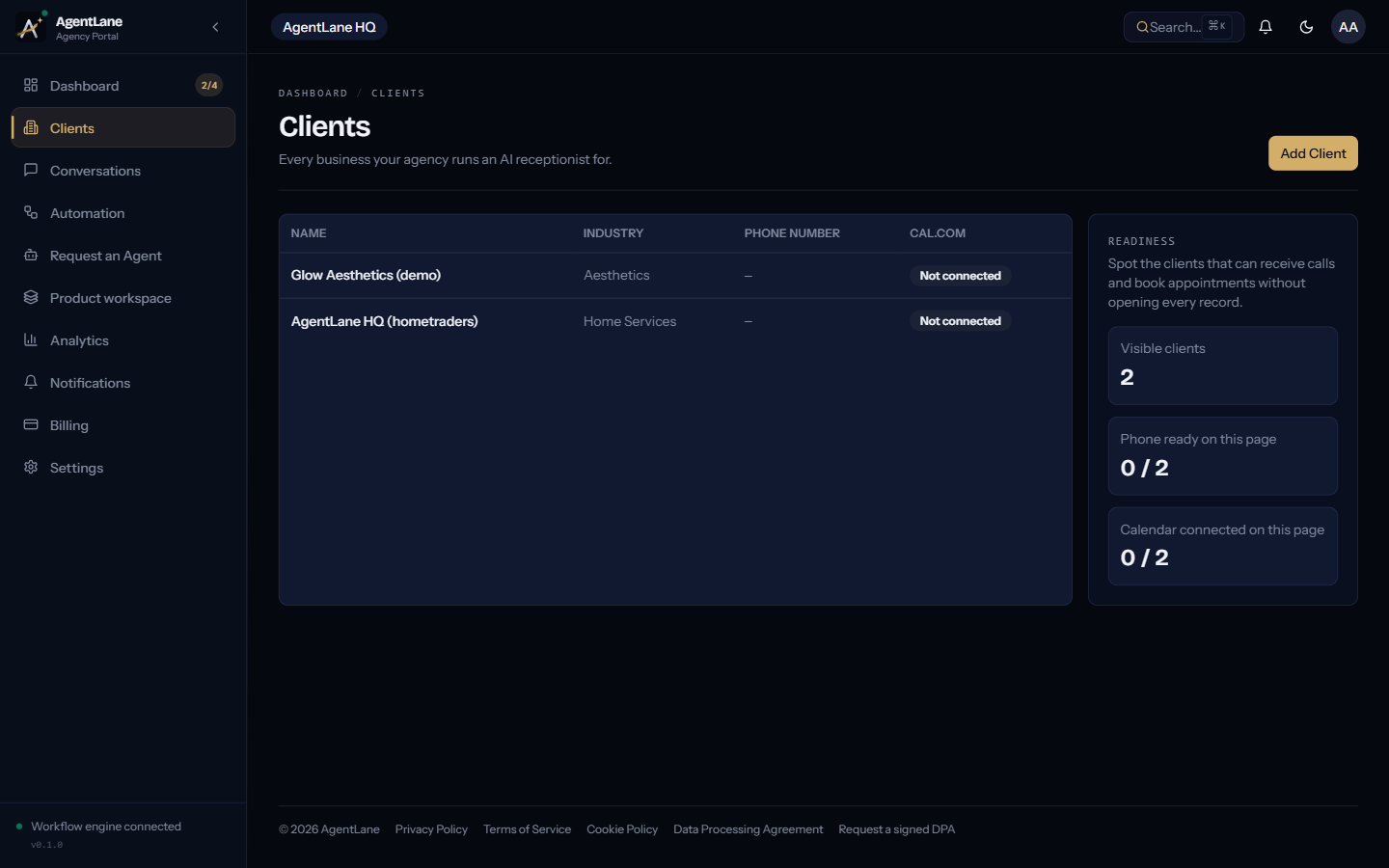
A white-label arrangement means running something closer to a real product line inside your agency: a client roster you manage, credentials you configure, a dashboard you check daily. AgentLane's own model is built around this — an agency partner manages a client list, requests agents from a fixed catalog, configures each client's specific details, and watches a real-time execution feed — all under the agency's own brand, at a flat wholesale rate of $199–$249/month per agent, per client (by plan tier) that the agency marks up entirely on its own terms.
Picking the right model for where your agency is
If you're testing whether a client base even wants AI automation, affiliate is the lowest-risk way to find out — no setup cost, no support burden, and you learn quickly whether clients bite. If you already know they want it and you want to build a recurring revenue line with your brand attached to the outcome, white-label is the model built for that, and it's worth running the margin math on a real client before committing.
Reseller sits as a middle ground worth considering when a vendor's specific agreement genuinely splits the work and the margin in a way that suits your agency better than either end of the spectrum — but read the agreement carefully, since "reseller" doesn't come with a standard definition the way white-label's brand-invisibility does.
Where to start
If white-label is the model that fits, see how the wholesale pricing works or go straight to becoming an agency partner.
I run AgentLane as a white-label programme specifically, not a reseller or affiliate one, because the margin ceiling and brand control matter more to the agencies I work with than the lower setup cost of the other two models — but which one is right for your agency depends on where you are, not which one I sell.
Frequently asked questions
- Which model has the highest margin?
- White-label, structurally — you set the client price entirely yourself against a fixed wholesale cost, so the spread is whatever you can command in your market. Affiliate margins are set by the vendor's commission rate, not negotiable by you. Reseller sits in between and varies by contract.
- Which model is easiest to start with no upfront commitment?
- Affiliate, by a wide margin — there's typically no cost to join, no client-facing support obligation, and no branding to maintain. The tradeoff is that it's also the model with the least revenue per client and the least control over the client relationship.
- Can an agency run more than one model at once?
- Yes, and many do — affiliate links for casual referrals that aren't worth full onboarding, reseller or white-label for clients where you want ongoing revenue and control. The three aren't mutually exclusive; they're different tools for different client situations.
- Does white-label mean AgentLane's name appears anywhere the client can see?
- No — that's the definition of white-label as distinct from reseller. Nothing of AgentLane's own branding surfaces to your end client: not the sender name on texts, not the voice on the phone, not the reports you forward. See the margin math post for how that plays out in practice.